I leave in three weeks to fly to Guatemala to embark on the mission of conquering three different volcanoes. I have been diligently training with intensive hiking treks, core exercises, and jogging for cardiac building.
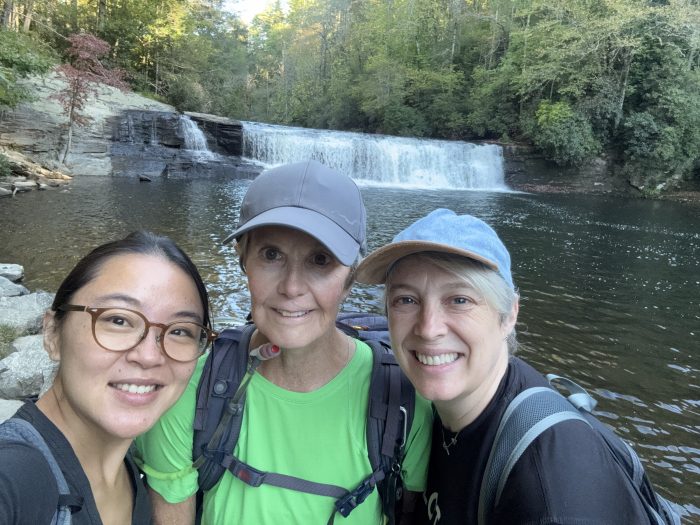
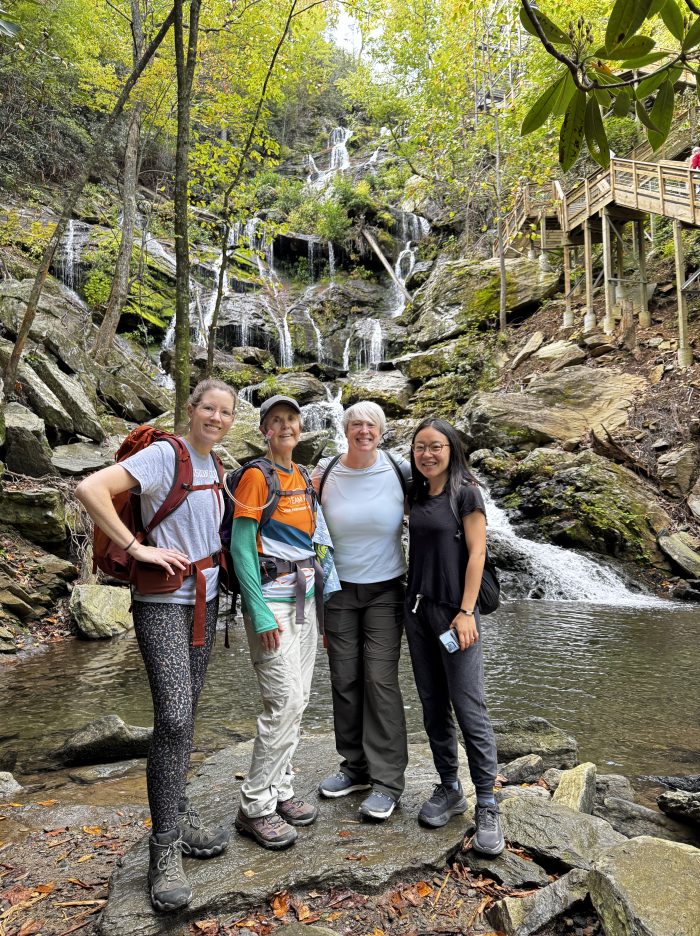
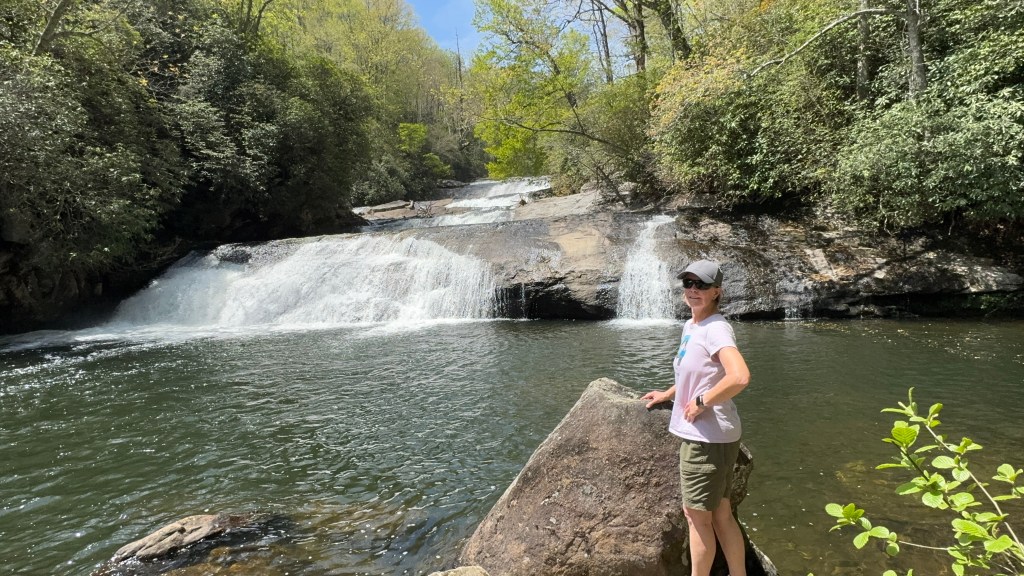
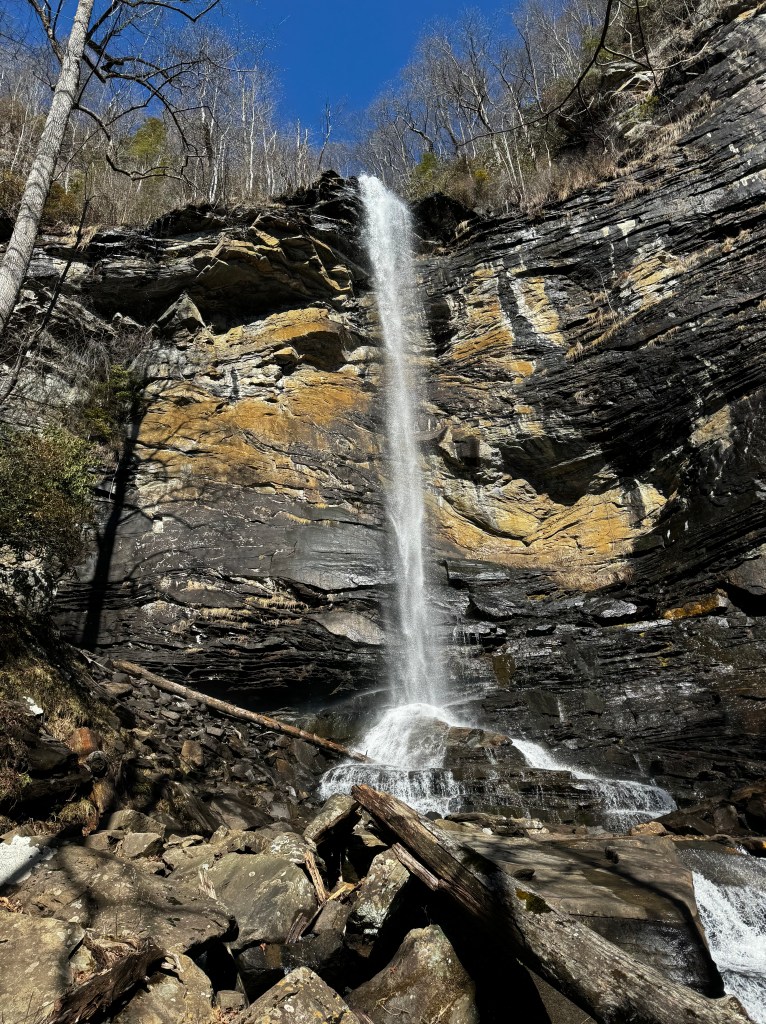
The first weekend of October, I had a mini reunion with 3 other women who hiked Mt. Kilimanjaro with me. One of those is Jo Simmons who was my tent mate on Kilimanjaro and will be my partner on the Guatemala challenge. Another woman is Connie Qian who came along to hike with us and cheer us on. We hiked three days straight. The first was immediately after picking Connie and Jo up from the airport and heading straight to DuPont State Park to hike the three waterfalls trail – High Falls, Triple Falls and Hooker Falls. It wasn’t a terribly challenging hike but did get my heart rate going and produced some sweat. Then on Friday we took on Raven’s Cliff Falls at Ceasar Head State Park in South Carolina. This was a 5.8-mile hike with 1320 ft. elevation gain. We put out some energy on this one. The hint of fall color showing off and the beautiful views were gorgeous. The third day, Laura Aldridge joined us for an arduous hike up the 535 stairs at Catawba Falls. We logged 3.8 miles and 853 ft. elevation gain for this one. The upper and lower falls were spectacular. It was a great reunion, an invigorating hiking retreat, and another event where fond memories were imbedded into our history.
Connie, me and Jo at Hooker FallsView from raven Cliff Falls hikeLaura, me, Jo, and Connie at Catawba Falls
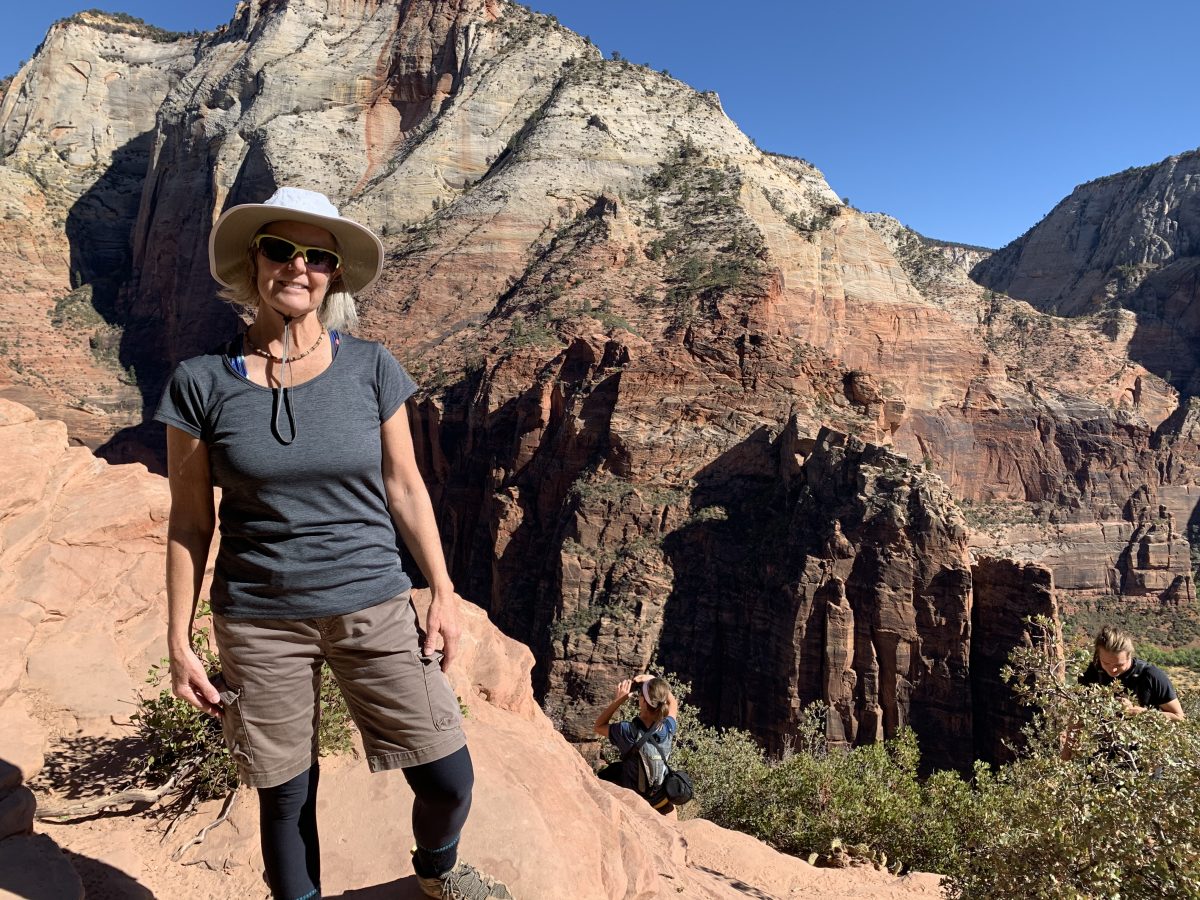
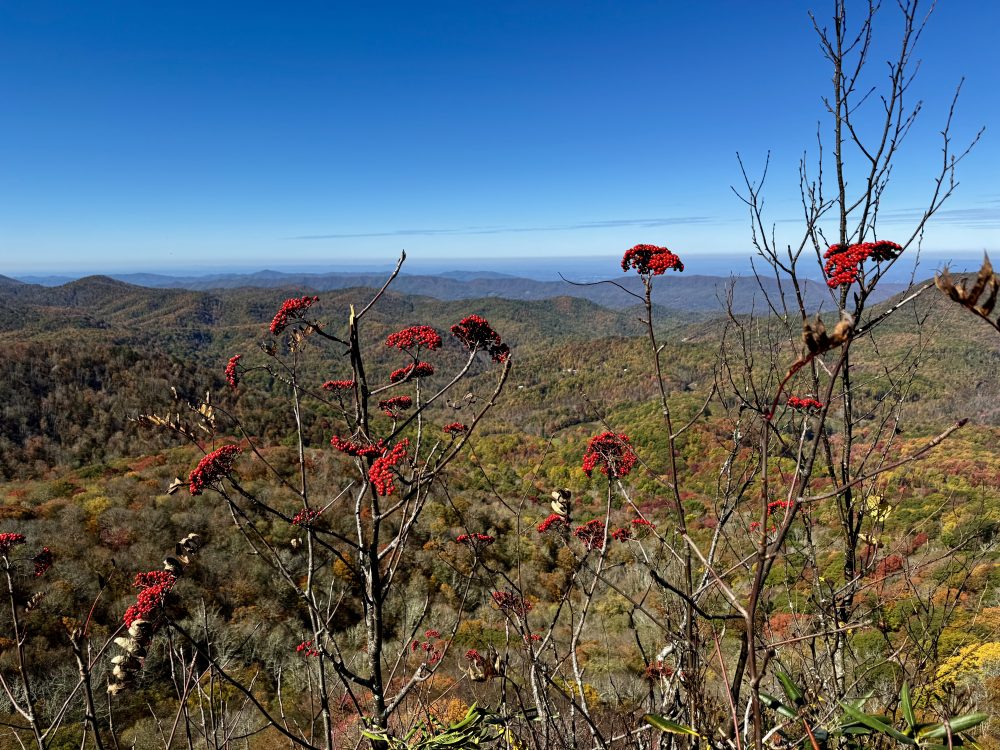
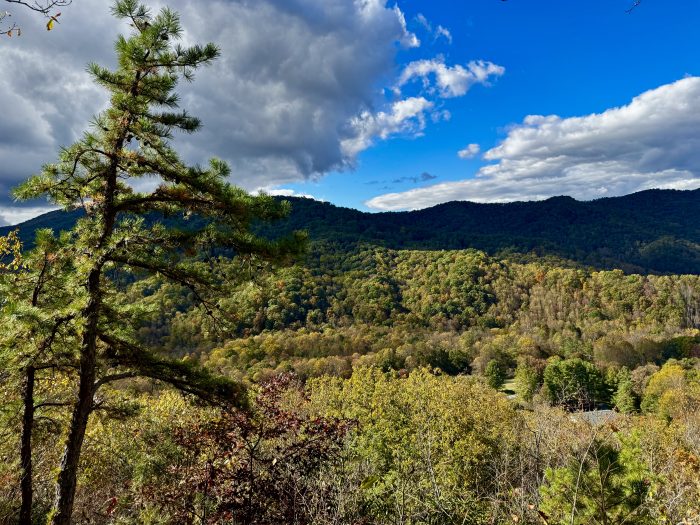
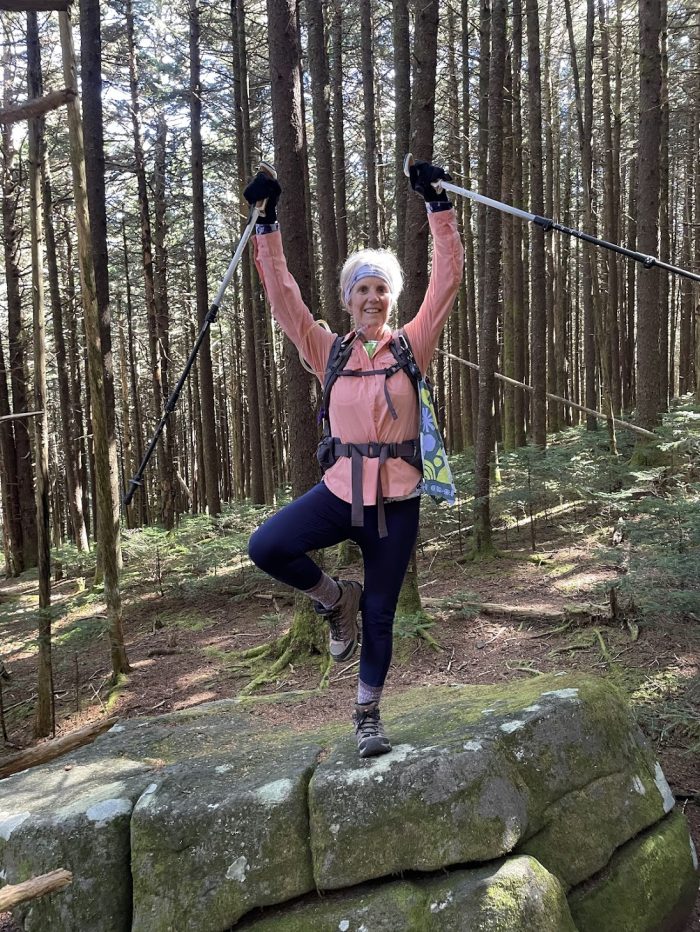
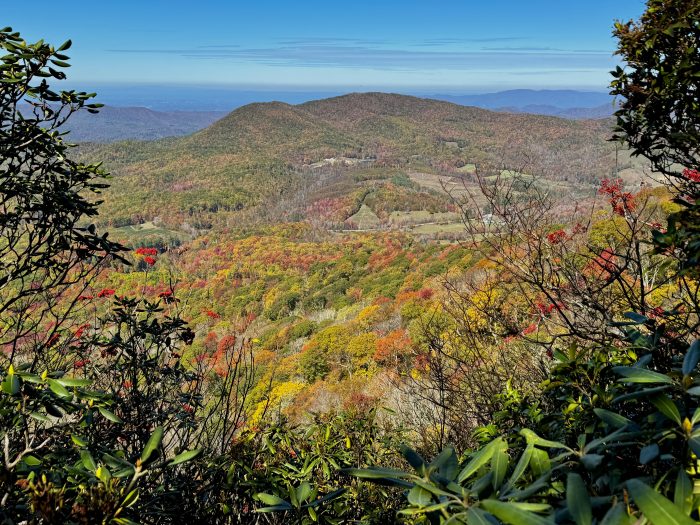
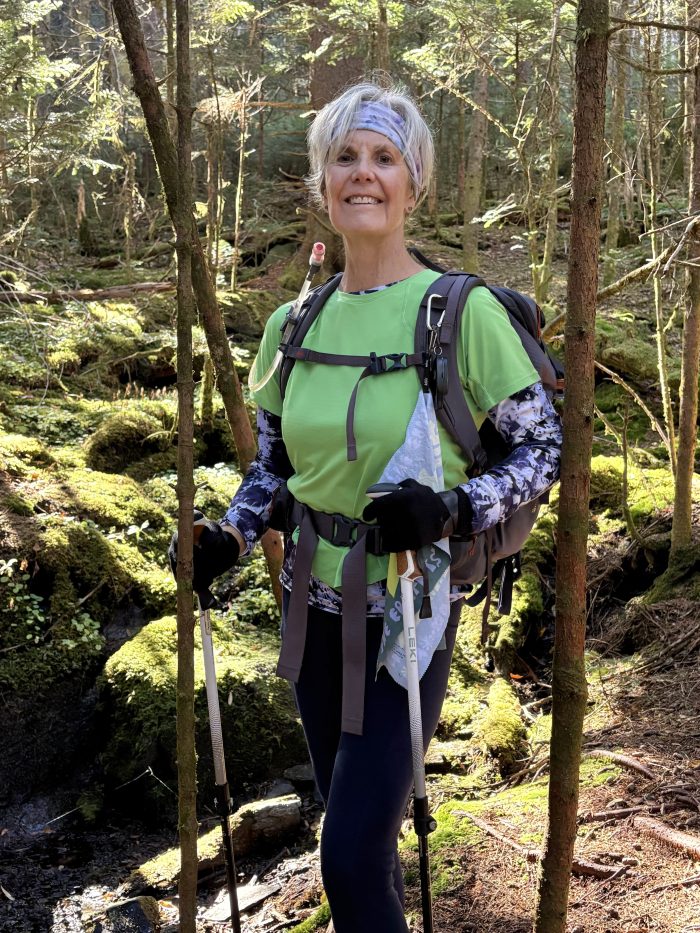
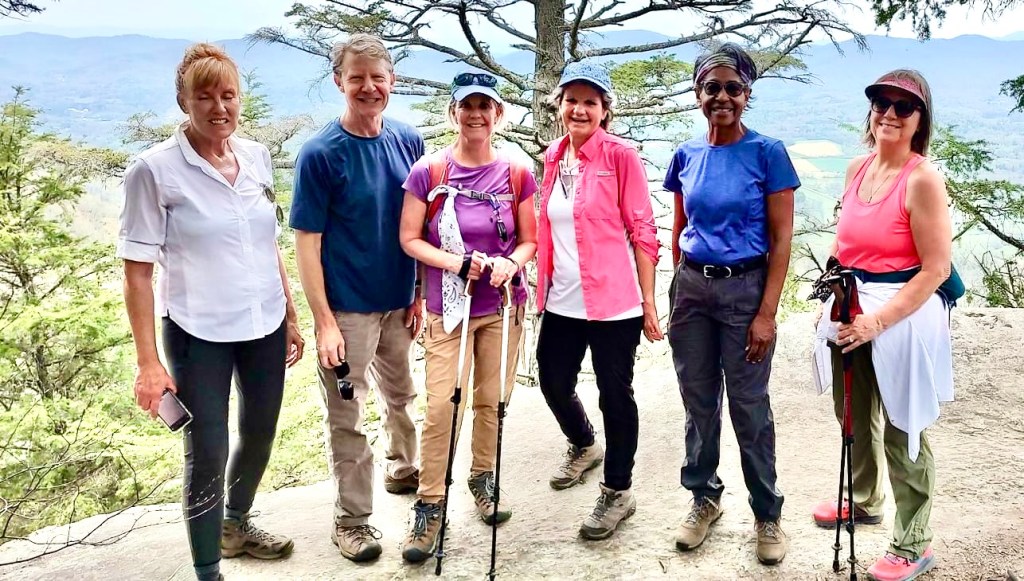
This week, I went on another hiking extravaganza. A few of my hiking friends stayed in a cabin at Roan Mountain State Park in Tennessee right on the North Carolina-Tennessee state line. We hiked three days and put in some good miles with elevation gains up to 1,090 ft. Collectively for the three days we did about 11.5 miles and 2,600 ft. elevation gain. When I consider that we will be hiking over 5,000 ft. elevation gain with 8 miles in just one day of the volcano challenge, it seems like a herculean undertaking. Hopefully, we will go slowly and have a lot of time to cover the distance. I’m sure we will be starting our climbs on the difficult days at sunrise, and we will have headlamps if we are on the trail before daylight or after sunset.
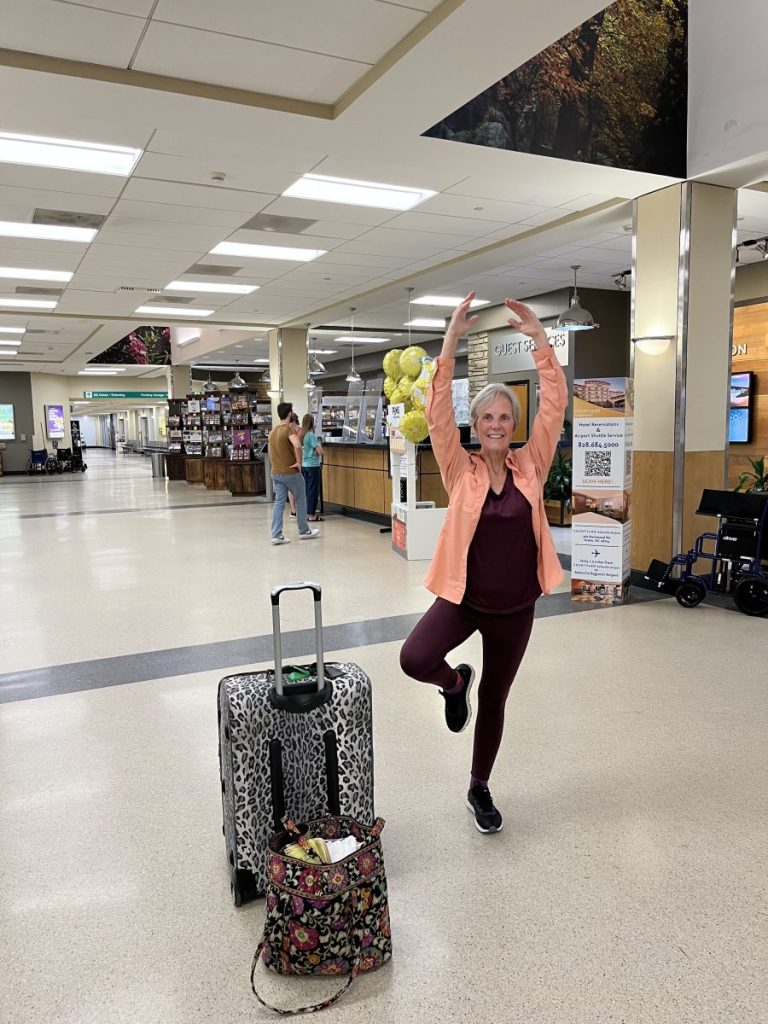
Still doing the pose.Hughes Gap trail view Enjoying the beauty of the mountains.
I have been deeply moved by the show of support given to me with my Parkinson’s journey and my efforts to make a difference to others with this fight. I hope that I offer hope to those facing the rest of their life with PD. I want to show that there is much life to be lived after hearing the words “you have Parkinson’s Disease.” I will continue to advocate for the PD community by fundraising for research, reaching out to legislators and being engaged with my local PD community.
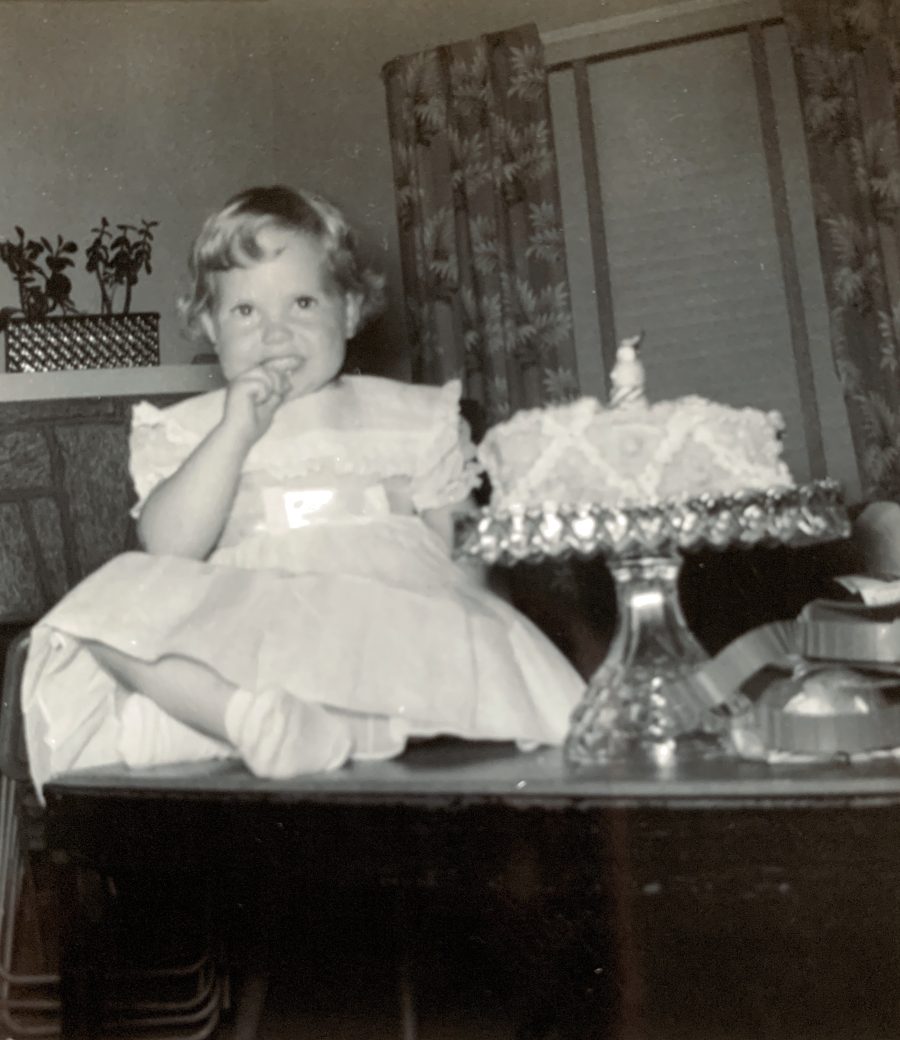
Today marks the 70th anniversary of the day I entered this world. The technology in the 1950’s was not advanced to know the sex of the baby before birth. In fact, I think a rabbit had to die to even confirm a woman’s pregnancy. Since my parents already had three boys they were hoping for a girl. As the story I heard many times over goes, there were shouts of happiness when dad delivered a baby girl. I was stubborn even at birth as I apparently didn’t want to breathe and vigorous efforts were made to stimulate me. It was a Sunday, and dad didn’t have surgeries or office hours that day but instead went out to play a golf tournament and won. The newspaper carried an article the next day about Dr. PJ Moore delivers daughter and wins at golf.
My memories go back to the late 50’s and 60’s growing up in a very different world than what is today. It is beyond amazing to remember the big console black and white TV that got three channels, had no remote so that one had to get off the couch to change channels and adjust the antenna and stopped broadcasting at midnight. Now, on a device just barley bigger than a credit card we can talk and send messages to people around the world, do our banking and business matters, take pictures and videos, store all those images, have access to a dictionary, Bible, atlas, extensive reading and listening library, get driving directions, research any subject, play games and so much more. I remember when the sound barrier was broken, John Glenn circled the earth, and Neil Armstrong walked on the moon. The advances in medical technology make old episodes of Star Trek seem prophetic as well as devices Dick Tracey and Get Smart used.
But what I don’t remember when I was young were many people with Parkinson’s Disease. There was an elderly gentleman in our community who had it. When I was in college, I knew my 80-year-old grandfather had it. My mom brought him from his home in Ohio to our place in North Carolina to take care of him and did a lot to rehabilitate him so that he could walk some. He died when he was 82 and I had recently graduated from college.
Today, there are many individuals diagnosed with Parkinson’s Disease. It is estimated that 90,000 people in the US will be diagnosed this year and 15 % of them early onset – younger than 50 years old. As of now, the worldwide estimate of people with PD is 10 million. It is taking over Alzheimer’s Disease as the leading neurological disorder. So, what is causing this trend?
In the last few months, I have read several articles about the risk of environmental toxins. The finger is pointed directly at Paraquat, an herbicide used to kill weeds and help lawns to look beautiful, as well as in agriculture. The dangers of living near a golf course and playing golf are being documented with alarming statistics raising one’s risk for PD. Other chemicals are being implicated as well like Trichloroethylene (TCE) used as a solvent and in dry cleaning fluid. There are other herbicides, pesticides, metals and organic pollutants as well. Some articles are indicating that PD may be largely preventable if these pollutants and toxins were banned. Of course, there are genetic risks and traumatic head injury that contribute too.
I do a lot of online reading and research to learn what I can about how to live life well with a diagnosis of PD. There are many products, devices, supplements, and how-to plans out there that offer some help with symptoms. Of course, the medication Sinemet or carbo/levodopa is the primary medication as well as a lot of others that help control symptoms. But the only proven way to slow down the progress of the disease is to engage in vigorous, heart-raising, sweat producing exercise for at least 30 minutes three or four times a week. I don’t get in as much as I need to every week but make a big effort to be out there trying to slow down this debilitating disease.
Since I have committed to hiking three volcanoes in Guatemala as a fundraising event for the Michael J Fox Foundation in November, I am trying to make an extra effort to be in shape. These events serve several purposes for me. They give me incentive to stay active and strive for being shape. I have found a wonderful support group in the Fox community. It has given me a way to reach others to offer hope, inspiration, awareness and show just what exercise can do. It has also given me a way to be a part of the solution by raising funds for research. One hundred percent of the funds I have raised through events I have participated in with the MJFF go to research. I could write more about the fantastic efforts of the MJFF as they do so much to provide information, raise awareness, work to advance legislation on behalf of the PD community and so much more.
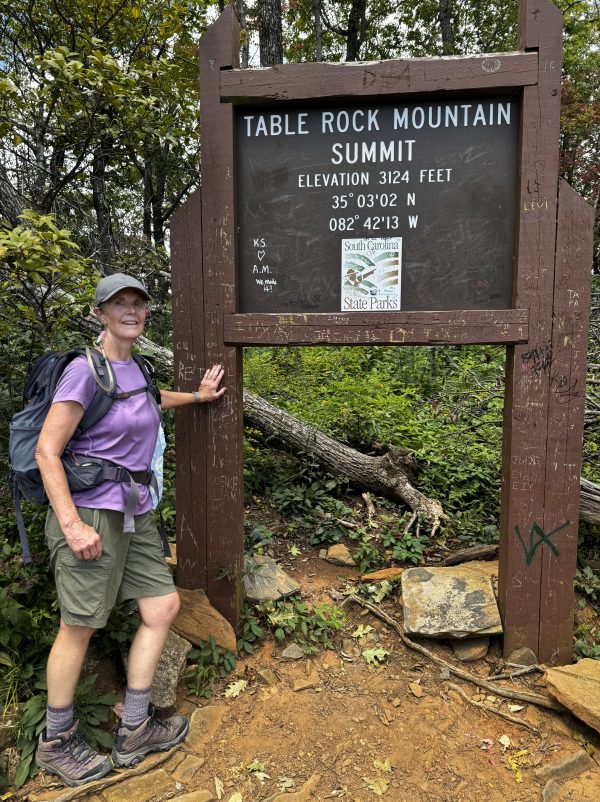
So as fall rolls in and I prepare for this monumental adventure, watch for me on the trails. I’ve recently been to the summit of Table Rock in SC and many other peaks in the mountains of Western North Carolina. A few days a week I’m out jogging in my neighborhood. I’m doing core exercises like push up and sit-ups. And lately, I’ve been doing a lot of yard work pulling weeds, dividing plants, hauling mulch. I’m going to get to the top of those volcanoes!
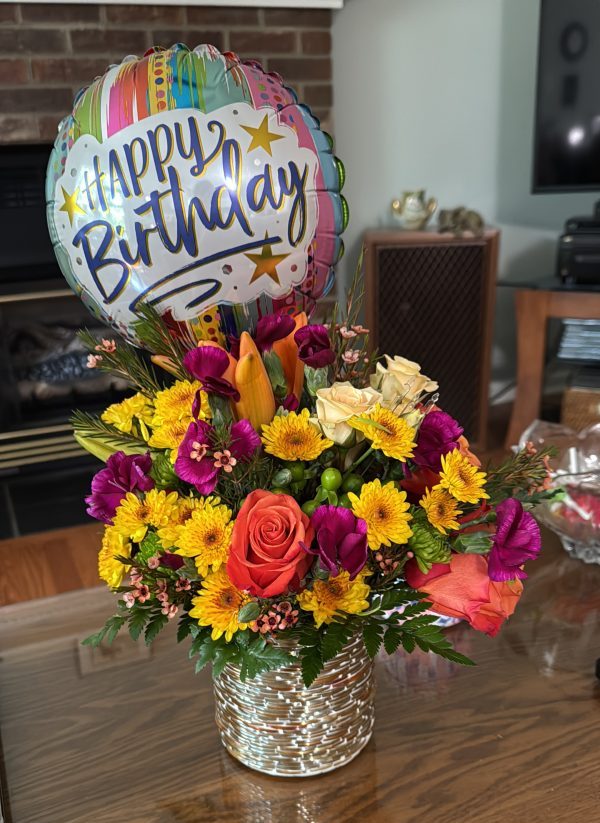
Flowers for me? Oh yeah, I’m 70 now.Table Rock – 7 miles and 2350 ft. elevation gain
I am conquering the 3 Volcano Challenge with Team Fox
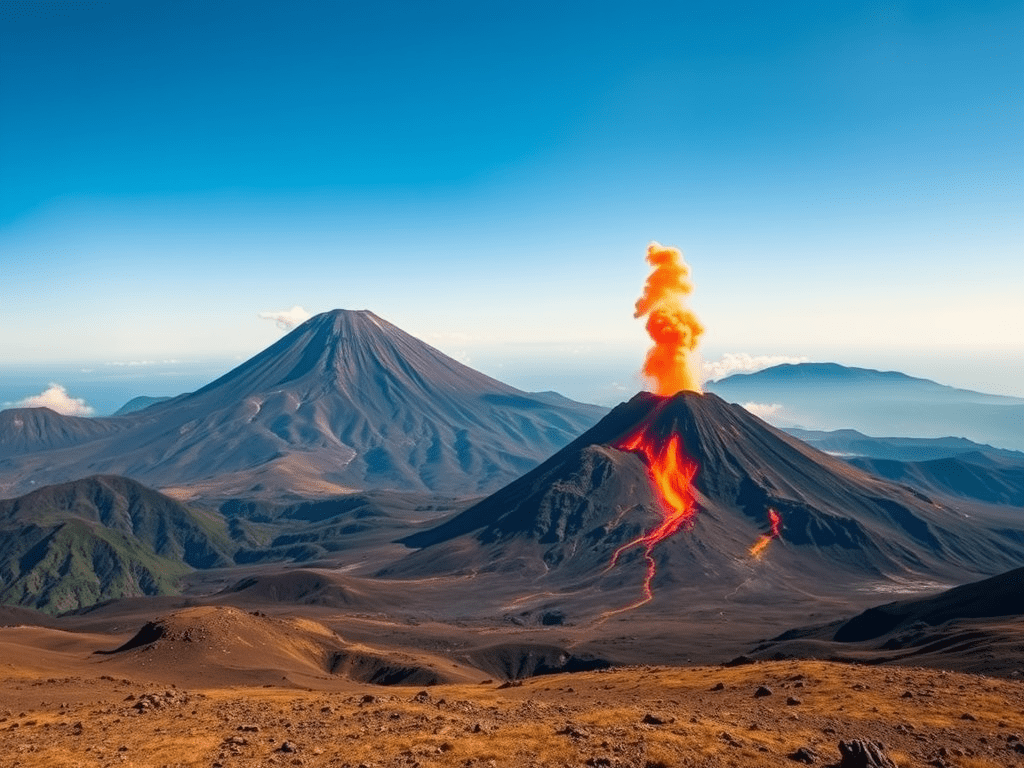
I am really excited about joining the Michael J Fox Team of Endurance Athletes again this year.In honor of turning 70 in September, I have decided to celebrate by taking on a new challenge. It will be a trek in Guatemala that includes three impressive volcano ascents. An undoubted highlight is sleeping on the side of 13,000ft Acatenango Volcano as the lava erupts from Fuego Volcano right before us. We also visit the impressive caldera lake of Atitlan and tackle a summit of the impressive Atitlan Volcano. This is a day trekking journey, across a wide variety of climates, including higher altitudes, and challenging days. We will climb over 10,000 ft. elevation gain in just one week. There is one day where the climb will require a 5000 ft. elevation gain. It isn’t the challenge of climbing Mt. Kilimanjaro but will test my endurance, nonetheless.
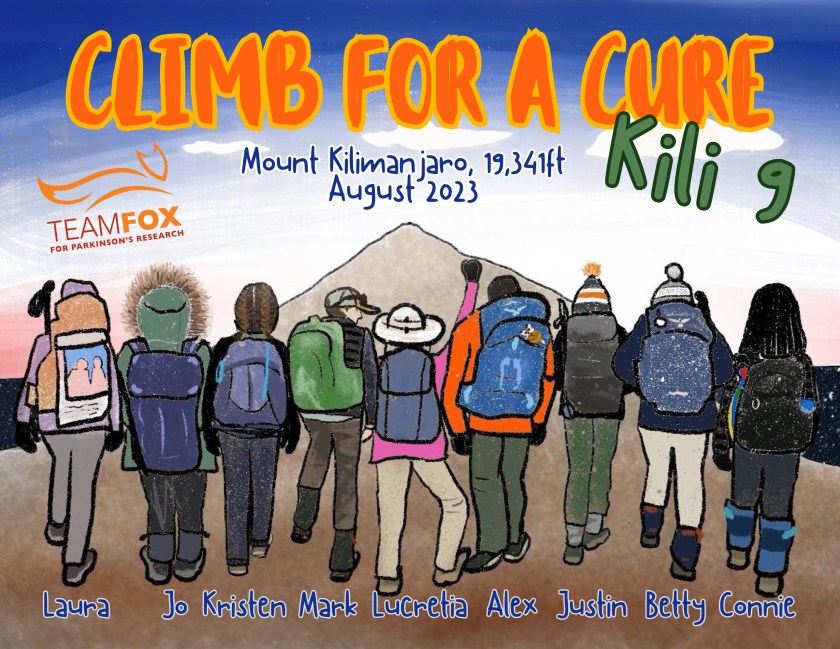
In 2017 I was diagnosed with Parkinson’s Disease. I learned early on the value of hard, vigorous exercise in delaying the progress of PD. Then in 2023 I became public about my diagnosis by climbing Mt. Kilimanjaro with 8 other climbers. It was an ambitious effort and was really hard for sure. I didn’t know if I could ever do a trek like that again. But, It changed my life and has inspired many who have PD and even those who don’t. It has also been an avenue to spread awareness. So, I want another challenge. Some of the hikers who climbed Mt. Kilimanjaro will also be on this climb. It is our passion to fund research and end PD, that drives us.
More than 6 million people worldwide are living with Parkinson’s — the second most common neurological disorder. In the United States, approximately 90,000 new cases will be diagnosed this year alone with about 15% of those being individuals under the age of 50. I invite you to be a part of finding better treatments and eventually a cure by supporting my fundraising campaign. One hundred percent of all funds raised for this effort go directly to research. Together, we can make a difference and end this disease forever.
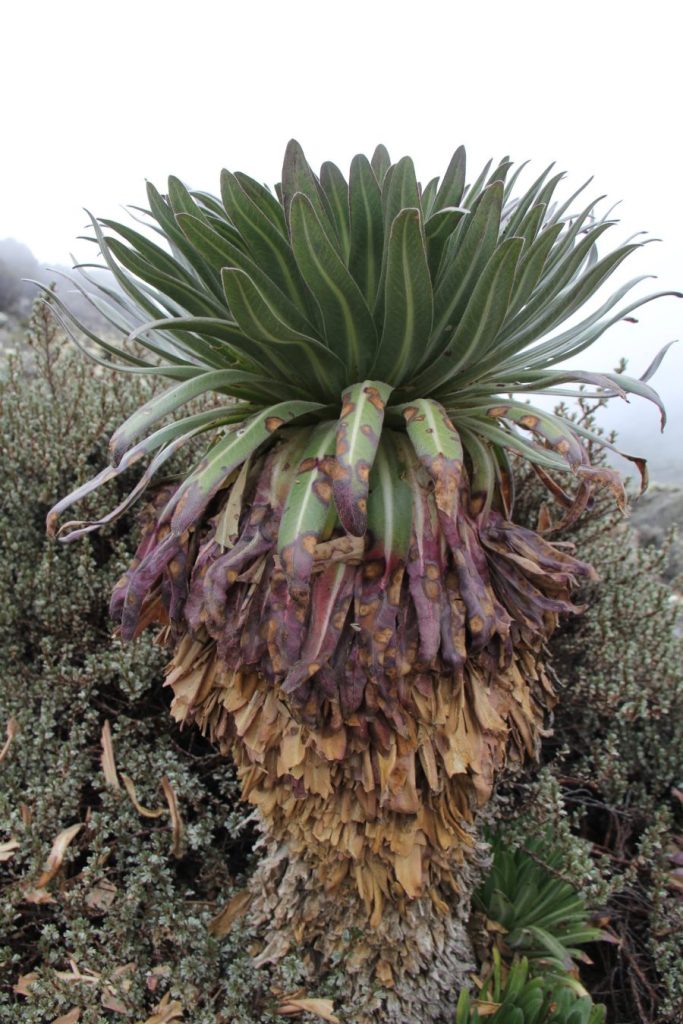
Just one year ago I was in Tanzania, Africa with a team of nine individuals who were destined to climb Mt. Kilimanjaro for the Michael J Fox Foundation for Parkinson’s Disease Research. I think about my climb almost every day of my life. My reflections vary from day to day. Sometimes I think about the beauty of the natural features in the four climate zones we had to trek through. The scrubby brush of the moorland was speckled with beautiful flowers and fun rock formations. Even in the desolation of the alpine desert and arctic zones there was great beauty. The sunrise at over 18,000 ft. was spectacular! The view of the world below from 19,341 ft. was breathtaking. The flowers and vegetation particularly around the oases were very pretty. The rain forest with it’s dense greenery and moss hanging from the limbs and the black and white colobus monkeys were unusual and fun. The clarity of the stars at night was awesome and made me feel small yet very connected to the universe at the same time. The feeling of reaching the summit at 19,341 ft. was overwhelming and exhilerating. I felt like I had been awarded an Olympic gold medal. But at other times I reflect on how arduous the week of camping in small tents, using primitive toileting equipment, sleeping on a thin pad and dealing with the ever present dust was. Hiking in thin air was very taxing and on summit night it was freezing cold. Sometimes, I relive how difficult it was to breathe while climbing steep grades covered in scree.
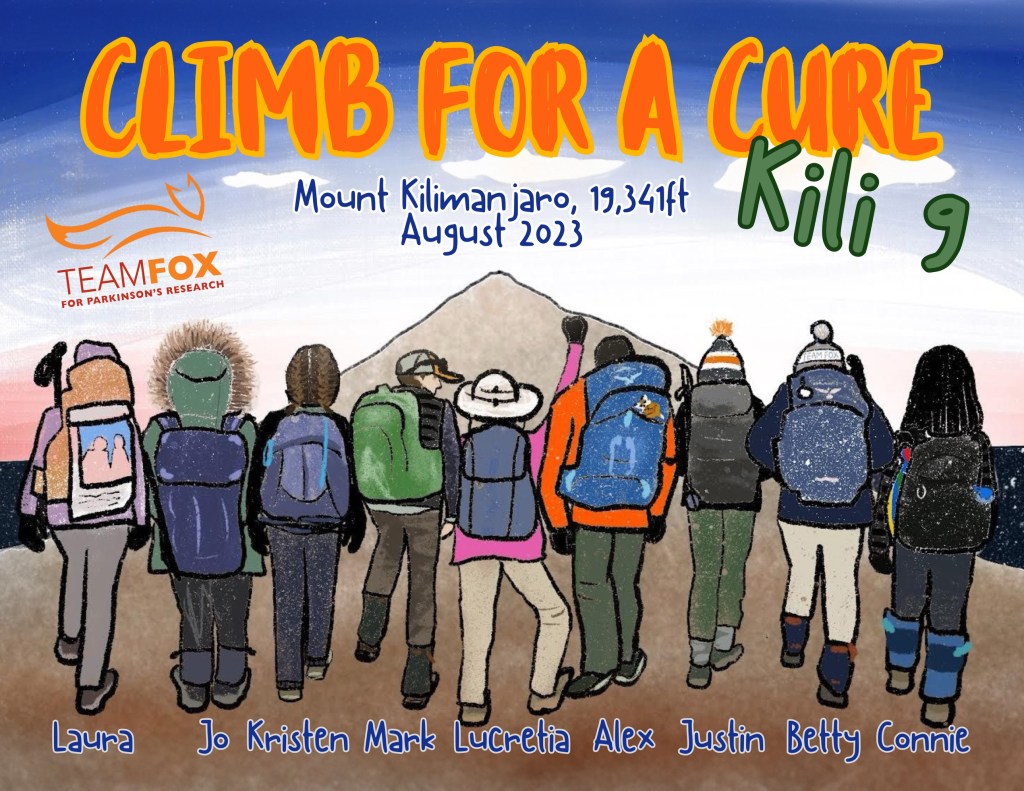
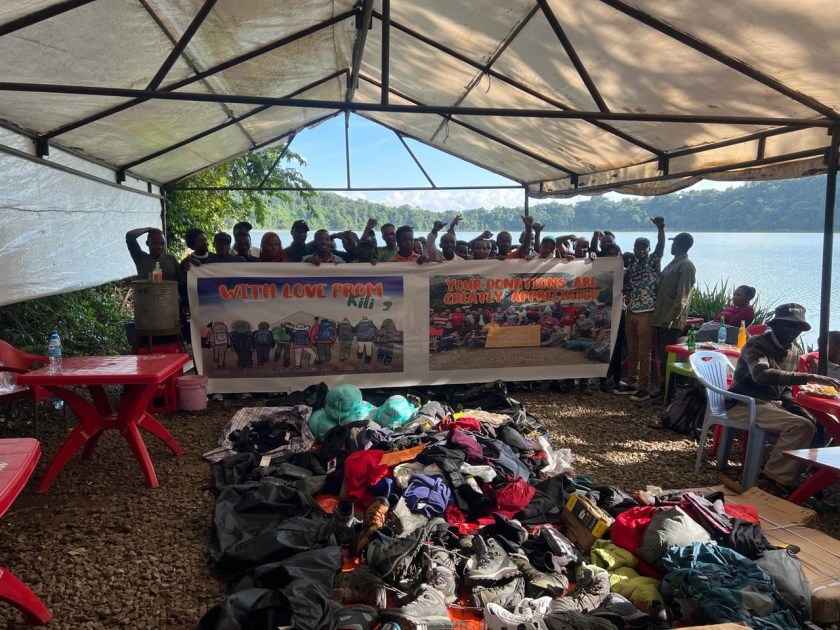
But, I feel the part of the trek that has stayed with me the most is the level of comraderie that I developed with the other 8 hikers and with the crew. Our group of 9 has stayed in close touch with each other all year and frequently text one another. Some of us have gotten together in person to reminisce and share time together. We fondly call ourselves the “Kili 9”. Four of us are planning to be together on August 14, the one year anniversary of reaching summit. I’m sure we will have fun recalling various aspects and moments of our climb. We’ll undoubtedly talk about events in our lives over the past year and plans for the coming year. The bonds of the relationships are very strong and offer a high level of support. Many of us have stayed in contact with certain key members of our crew. Jo even organized getting some of the crew into guide school and English classes so they could apply to guide school. She also organized getting a huge amount of clothing and gear to our guides and porters who so kindly took great care of us on our expedition.
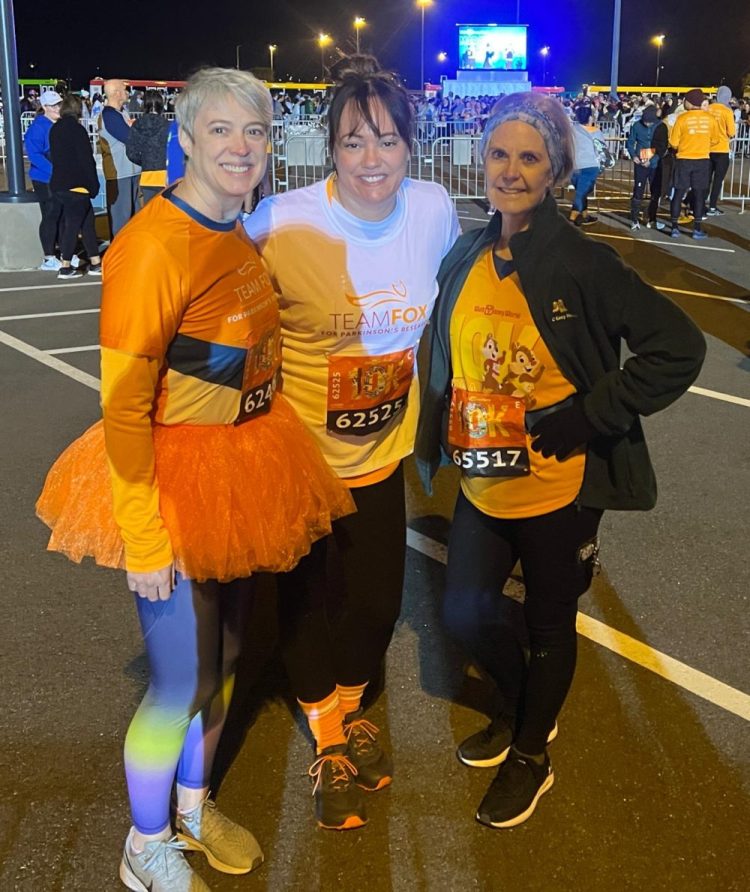
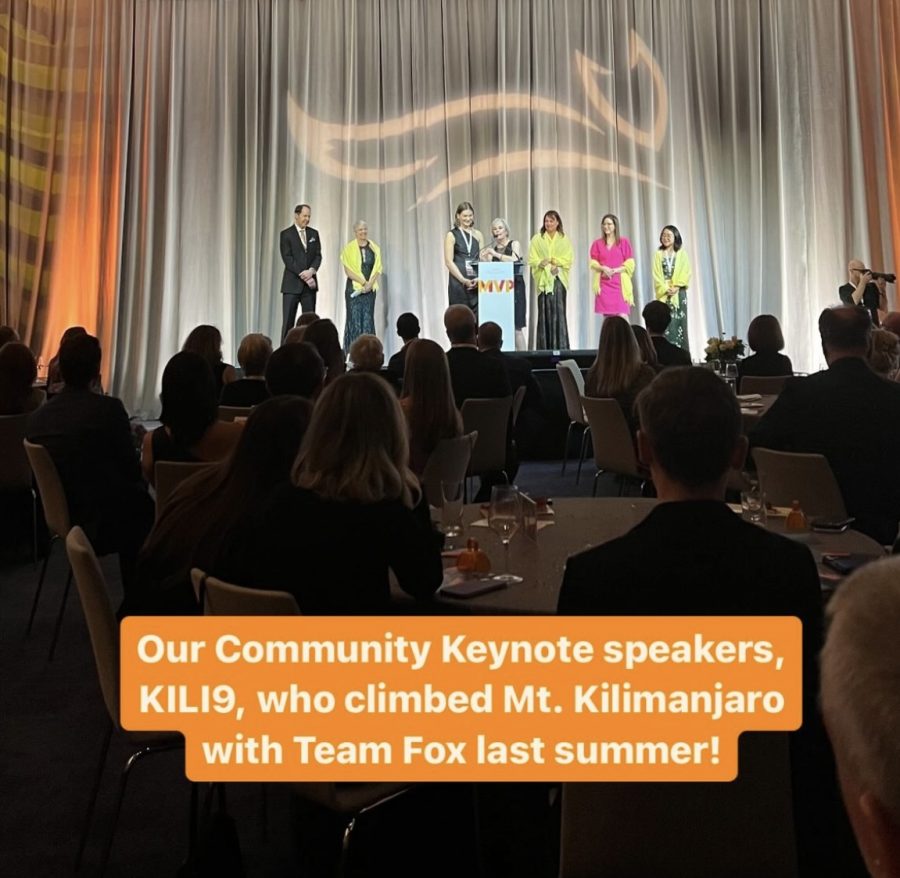
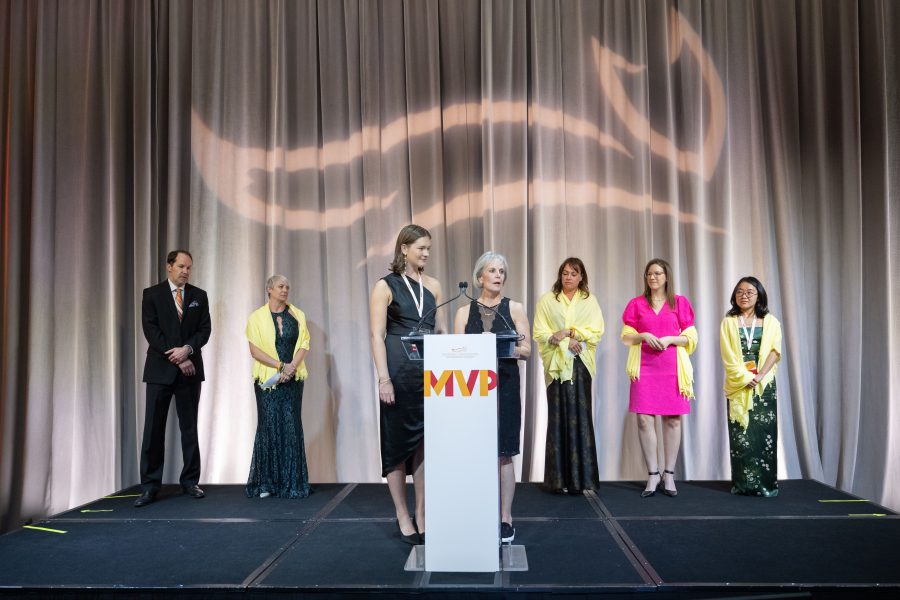
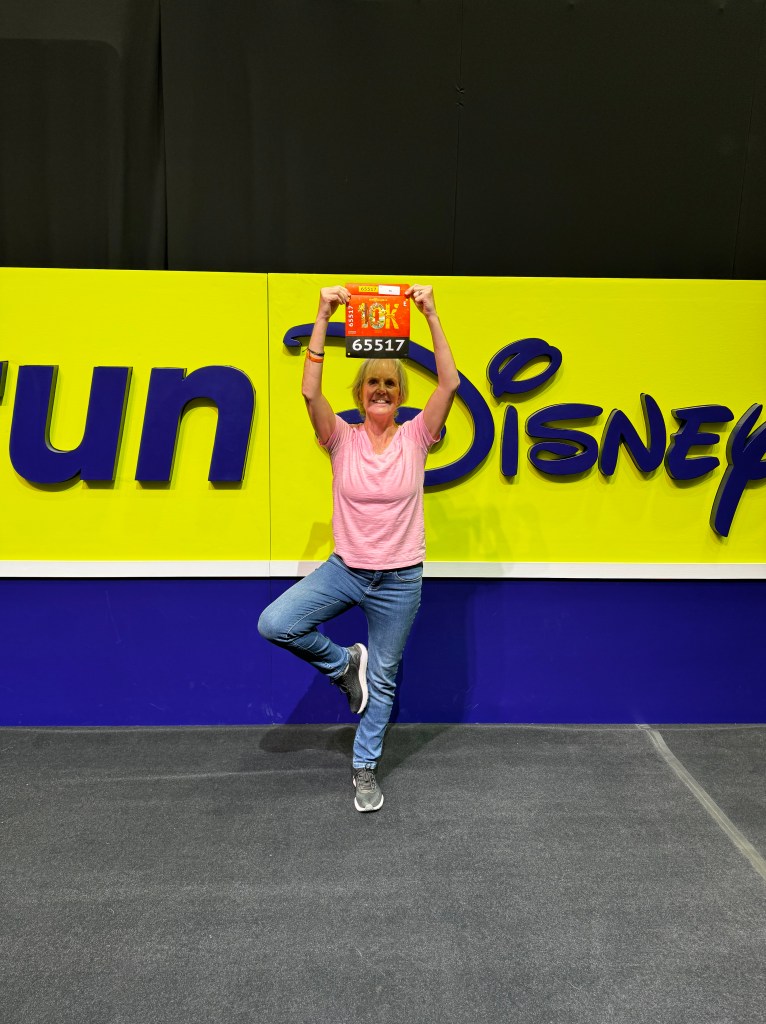
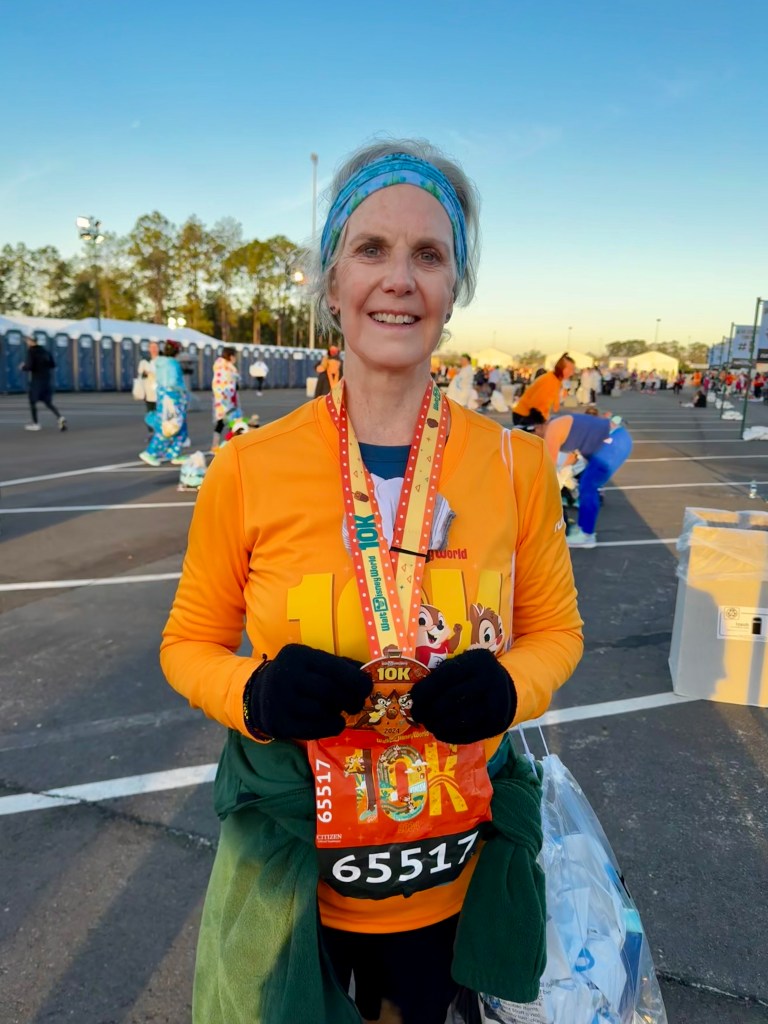
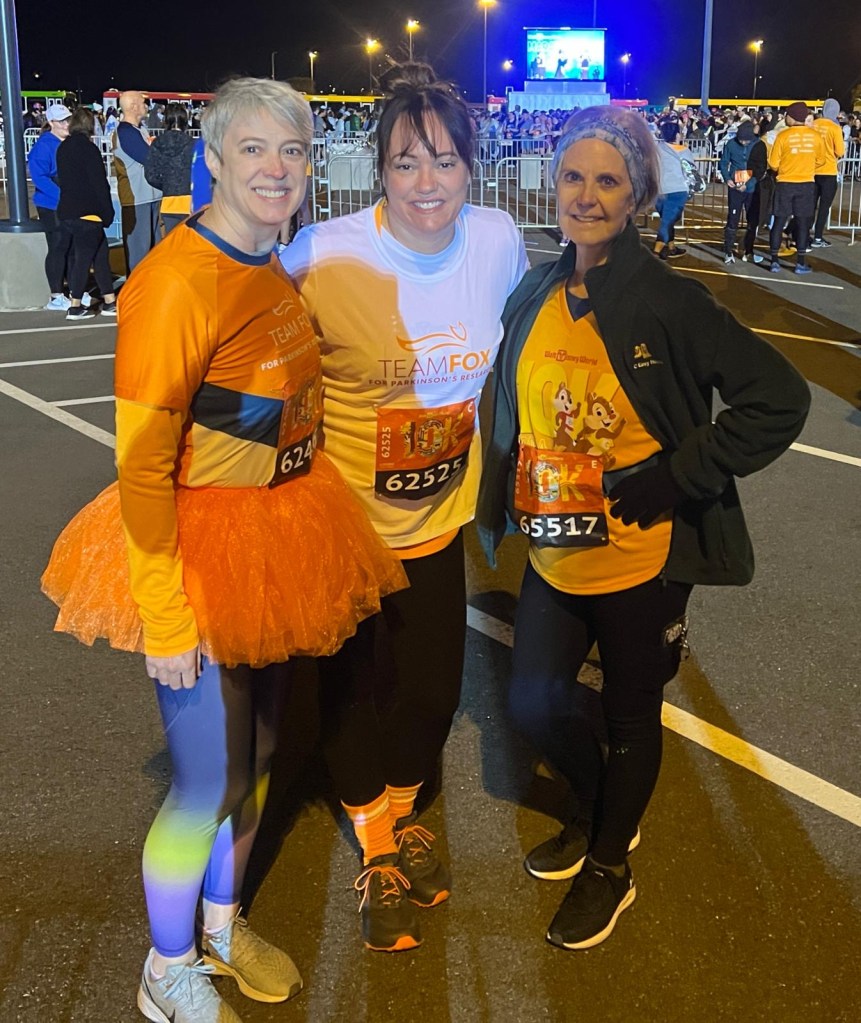
I continue to be involved with the Fox Foundation. I participated in a 10K at Walt Disney World on it’s behalf this past January with plans to do so again this coming January. We were honored to be the keynote feature at their MVP Awards Gala event held in NYC this past April. I remain in touch with some of the staff at the Fox Foundation. Who knows. I may do another climb with them next year but not Kilimanjaro again. I’ve been there and done that.
I have given presentations of my climb to various groups with more scheduled. People have been very receptive to my story and have been very supportive. I will continue to advocate for those affected by Parkinson’s disease. I also continue to plan weekly hikes for my group of hikers. It has been an incredible year of life changing experiences. I will continue to live life fully and vibrantly as long as I can. I just need to remember to put one foot in front of the other and keep going. Thanks to all who have supported me in many ways as I travel this journey with Parkinsons’ Disease. May each of you find your way to live life to the fullest.
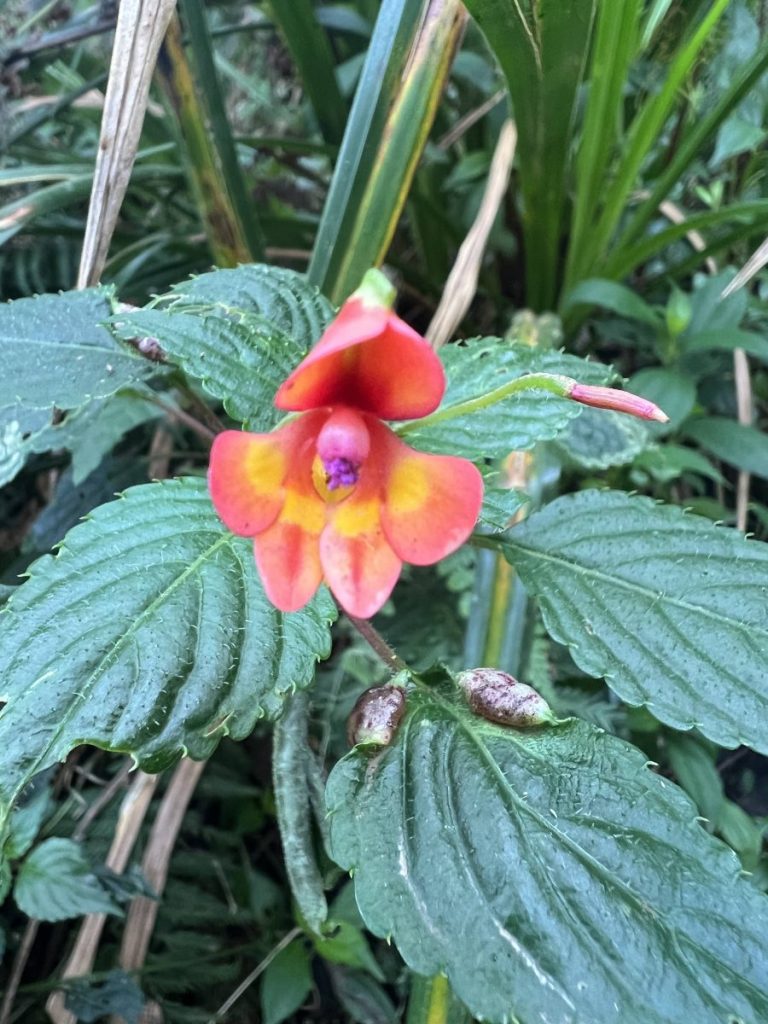
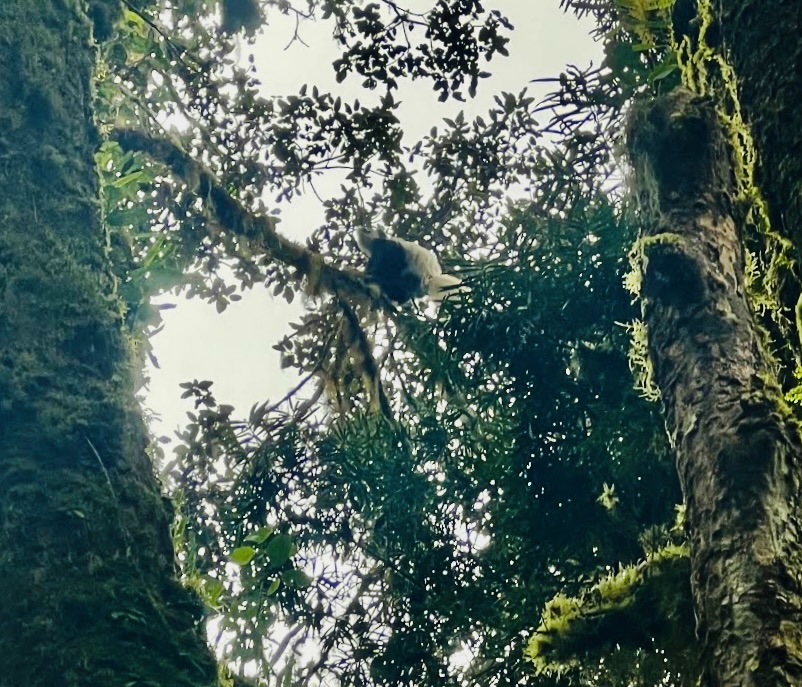
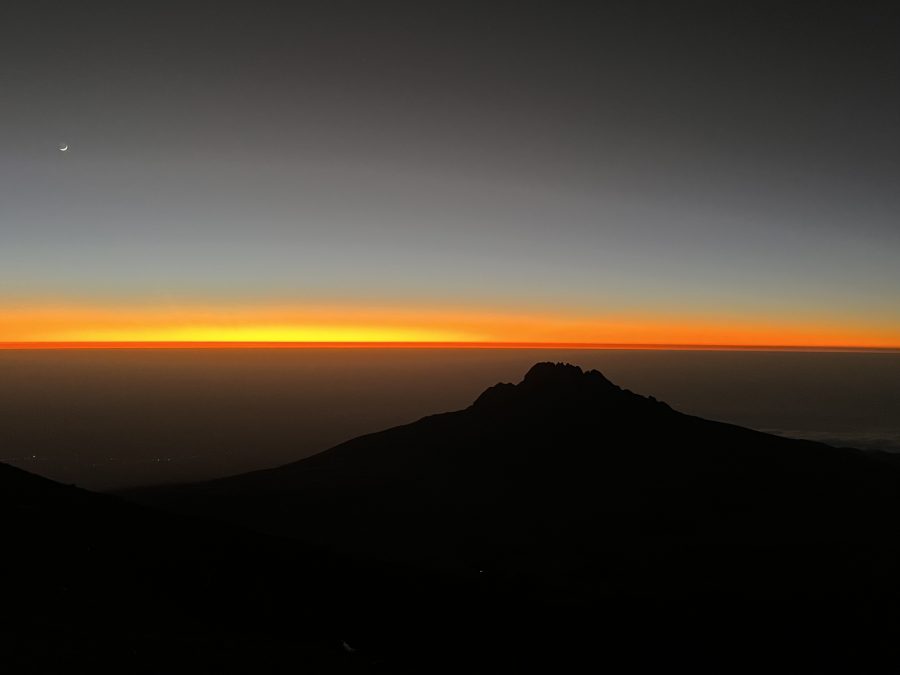
xr:d:DAF6Lv_7cVY:25,j:6934833533121747672,t:24011919Sunrise at 18.000 ft.flower of the rainforestBlack and white Colobus monkey10K at WDWMVP Gala Featured speakersStill hiking and leading hikes
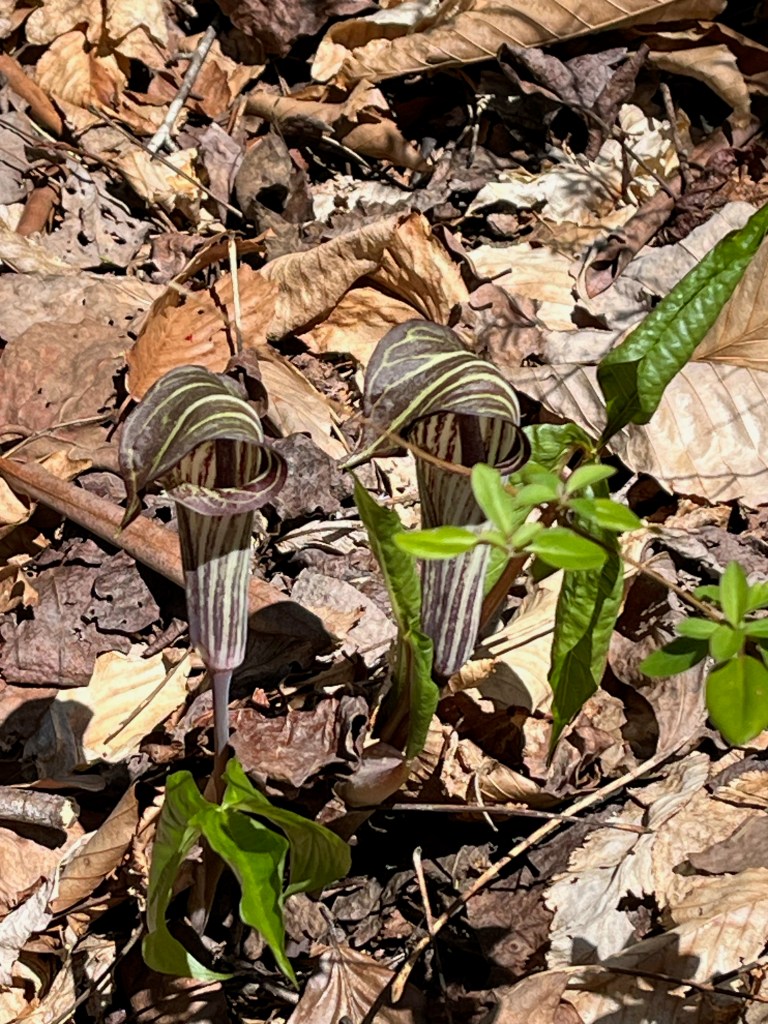
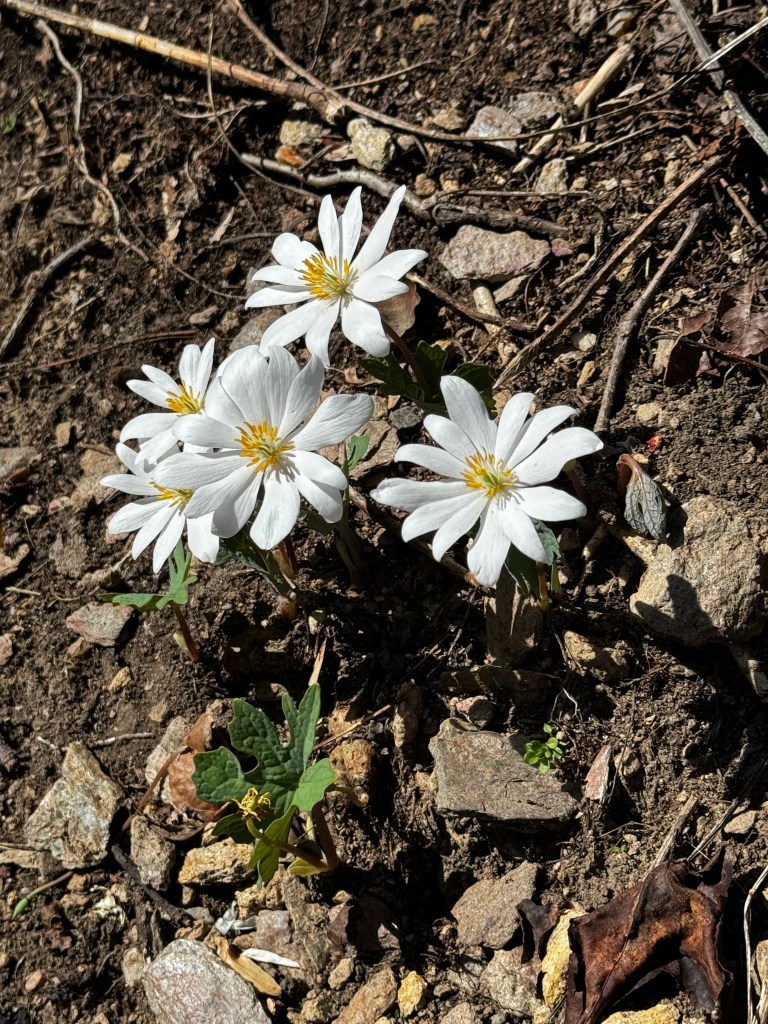
It’s been seven months since I came home from Africa. The journey to 19,341 ft along with the long flight home and ensuing jet lag took a lot out of me. My recovery took at least a month or more. To be honest, I’m not sure I’ll ever be back to where I was before the climb. I have resumed a normal life though. I continue to hike weekly and plan outings for my hiking club. We’ve gone to some very beautiful destinations here in the beautiful mountains of western North Carolina. Just this week we went to the Green River Gamelands State Park and hiked along the Green River. The trail was abundant with the emerging spring blooms including Jack-in the- Pulpits, Bloodroots, Sweet Betsy Trilliums, and others. I am grateful for every day I can get out and walk and hike on my own two feet.
I continue to be an advocate for the Parkinson’s community. I have a 60-minute power point presentation of my climb up Mt. Kilimanjaro that I have presented three times with more engagements on my calendar. I’m seeking further opportunities to give this presentation so if you can help me find speaking engagements, I would appreciate your help. I also went to Walt Disney World in January and participated in a 10K event on behalf of the Michael J Fox Foundation.
Our group of nine who summited Mt. Kilimanjaro last August have been invited to be the keynote feature of the Michael J Fox Foundation’s MVP Awards Gala in New York City on April 6. I will be speaking at the event along with others from our group. I feel truly humbled and honored to be part of this happening. The climb changed my life forever. I experienced the majesty of Mt. Kilimanjaro, a magnificent natural wonder. I watched the sunrise from over 18,000 feet. I saw the stars and Milk Way as I’d never seen them. I felt connected to a greater force outside myself like I have never experienced before. I found a new family there. I became part of an organization making a difference in this world. And I have a connection to the people of Tanzania.
I want to give you an update for those who contributed gear and funds to help our guides and porters who took care of us with kindness, respect, professionalism, and concern for our safety. Jo and Kristen, two of the women who climbed, are in Tanzania now and delivered a mountain of items to the staff. They were grateful beyond words for the boots, sleeping bags, water bottles, socks, jackets, pants, shirts, hats, and other items that will make their trips up the mountain safer and more comfortable. Some did not have the clothing to keep warm or shoes to make their footing safer. They shared water bottles. Some didn’t have a sleeping bag to stay warm at night. Many of you made a real difference in their lives and they want to say a huge thank you. I want to thank you too. This is what life is about – helping others along the way and sharing the journey.
This is the last chapter of my Climb Kilimanjaro adventure but not the end of my journey with PD. Look for more posts in the future.
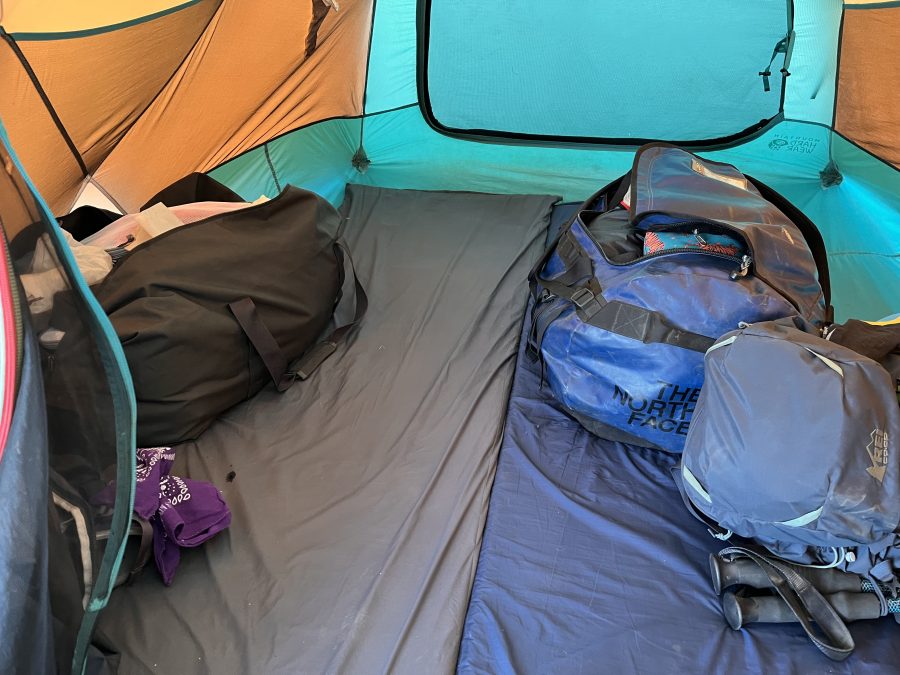
As I settled into my sleeping bag on that 6th night, I was very glad it was the last night I would be spending in that tiny tent, on the ground, and without indoor plumbing. Many people like me, with Parkinson’s disease, have sleep issues so I hadn’t really slept well the whole trip. This was in addition to taking Diamox twice a day for the prevention of altitude sickness. It works by being a diuretic. I had climbed the Barranco wall, a 1000 ft. sheer vertical rock cliff where a slip could plummet one off the face to most certain injury or death. We have since learned that the man we saw being carried out on the stretcher the day we scaled the Barranco wall died. I had climbed all through the night going from 15,300 ft. to 19,341 ft. in three miles to reach the summit. All the hiking we had done had been above 11,000 ft. with most of it above 13,000 – 15,000 ft. We also learned that two other people died the same week we were on the mountain most likely from altitude sickness. We had weathered sun, wind, cold, and steep, rocky, scree strewn trails. Yet the most difficult part of the whole journey was taking care of the calls mother nature made and managing the small tent space. At the beginning of the trek, I would look for a rock to hide behind to do my business but by midweek, I didn’t care who saw what. Many people with PD have difficulty holding back when the call to pee comes. My group learned early on that if I said I needed a “trail break”, I would need to answer the call very quickly or risk having an accident. Diamox along with drinking a lot of water to stay hydrated, made these calls come frequently along the way and they came two to three times a night. Pulling off to the side of the trail was easy compared to what I had to accomplish in the tent. First, I had to get out of the warm and relatively comfy sleeping bag. Next, was to get the tent entrance unzipped. Getting the zippers to slide was a very difficult task and one that I rarely did by myself. This meant that Jo had to wake up too and help get the zippers to work. Often, we both had to work together pulling and fidgeting to get them to unzip. Then I got my very dusty boots out of the bags in which they were stored inside the tent. I would set them just outside the tent entrance and then try and get my feet into them which again, was never easy to do. By this time, I was struggling to hold the pee, but I still had to get my long johns down, squat over a bottle and hope the positioning was right to collect the pee. Then I had to do the reverse order of pulling up the long johns, screwing the lid on the bottle, sit inside the tent with my shoes outside and get them off, store them back in the bags and get the zipper closed. This occurred two to three times a night in the dark, cold air. Then it was dawn and the ritual of packing up the gear and dressing for the days hike started.
On that last morning I was very tired and even felt weak when I woke up. I found a clean shirt to put on and decided to wear long johns and leggings as we would be descending where it would undoubtedly be warmer. As I was packing my duffel bag I couldn’t find the hard case for my bifocals which I wore in camp. I had non bifocals for the trail so I wouldn’t be thrown off looking down on the trail. I needed to keep the bifocals safe, so I was desperately trying to find the case when January came to my tent and asked what I needed to get ready. I told him I was trying to find the case but I’m not sure he understood. I gave up and put the glasses in a secure pocket and hoped they wouldn’t get scratched. By the time I got to the mess tent I only had time for a few bites of breakfast. The crew was ready to get packed up as we had a good distance to cover that day to get out of the park. The group made its way to the High Camp gatepost for a picture before beginning this last leg of the trek. Then back to our camping site where we were treated to our crew of guides and porters singing the Kilimanjaro song to us. It was a fun rendition with each of us being named in the verses and members of the crew picked up Laura, Connie, Betty, me and pulled some of others to dance with them in the middle of the ring. Everyone was happy and smiling on that sunny morning as we put on our daypacks and began the last leg of this incredible expedition.
The Kilimanjaro song
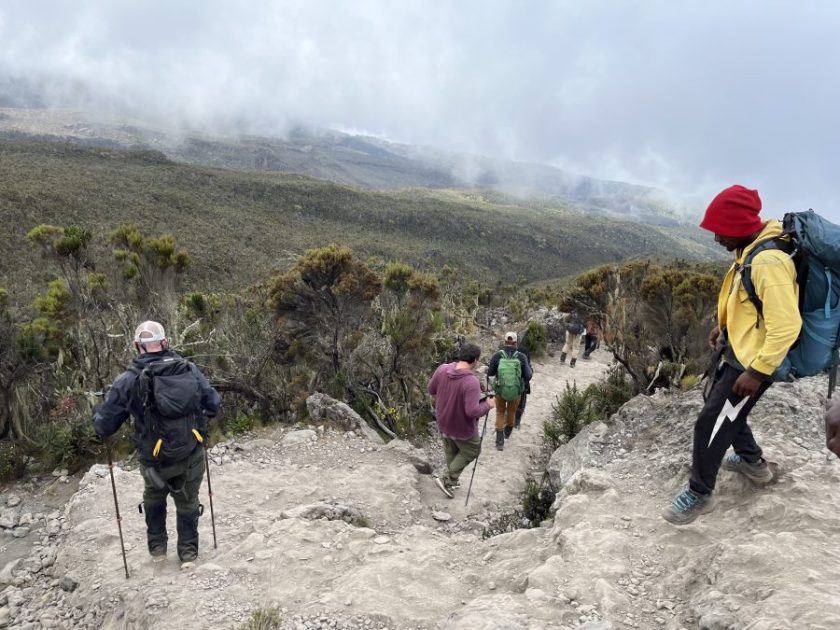
The trail started out very steep with large rocks creating deep steps. As I stepped down that first section I felt a sharp pain in my right butt cheek. The pain was so sharp that my leg faltered causing me to wobble and I almost lost my balance. At the same time, I felt lightheaded and dizzy. I was bringing up the rear of the line with Abel right behind me who noted my stumble. He instructed Matthew to take my daypack and I told him I needed my poles to steady my gait. So, Abel took my poles out of his bag and gave them to me. I also got one of my GU gel packs and sucked out the sweet, gooey contents. This gave me almost instant energy which enabled me to continue without feeling like I was going to faint. But as I continued down the trail, the pain was almost unbearable. I knew there was only one way off the mountain which was to put one foot in front of the other and keep going despite the pain. I was hoping the pain would let up as I trudged on, but it did not, so I told Abel I needed to stop and get some Tylenol. I knew I had some packed somewhere in my daypack, but I could not find it. Abel said Alex had some so the group stopped while Alex found his Tylenol and I took two extra strength capsules. Then I had a nature call. By this time, we were out of the alpine desert and there was good enough vegetation to find a place of privacy. I was still in a lot of pain and getting situated to accomplish emptying my bladder took time. Trying to squat was difficult so I took a while to do my business. When I returned to the group, Alex asked if I’d had a good pee. I wanted to ask what made the experience a good pee? Was it having the feeling of relief from a full bladder? If so, then it was indeed a good one but everything about accomplishing the task was difficult. Fortunately, my hikers back home had taught me the advantage of wearing panty liners to manage the drip on the trail, so I didn’t need to use TP. This was invaluable to me for the entire time I was on the mountain.
Beginning the last leg
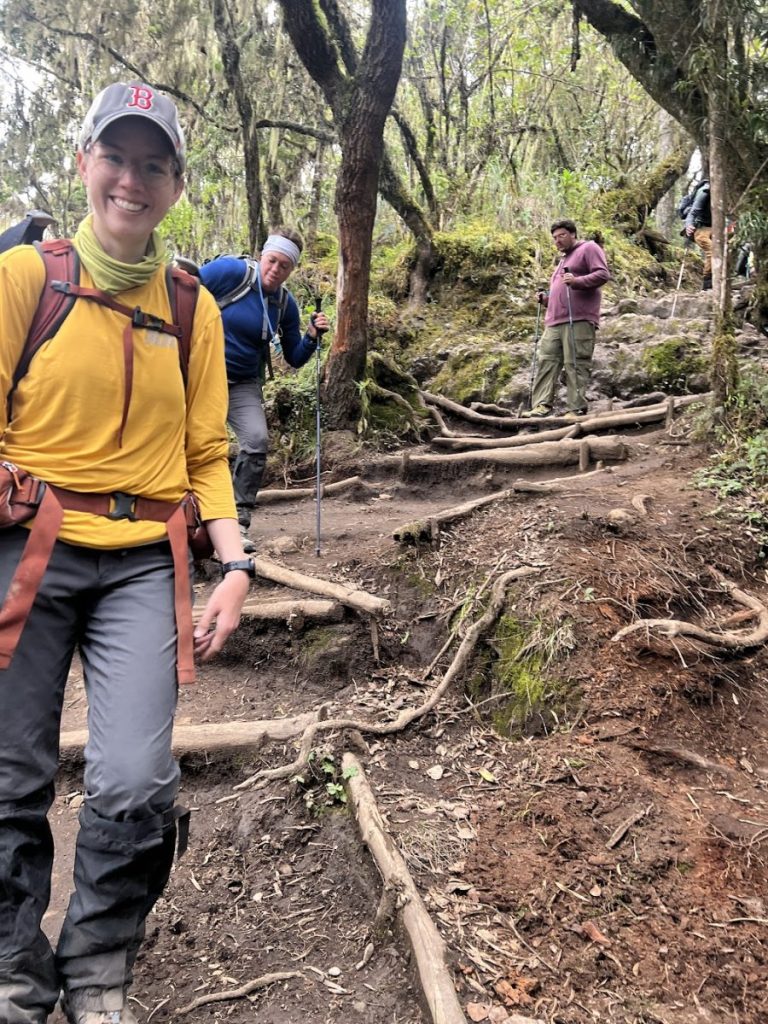
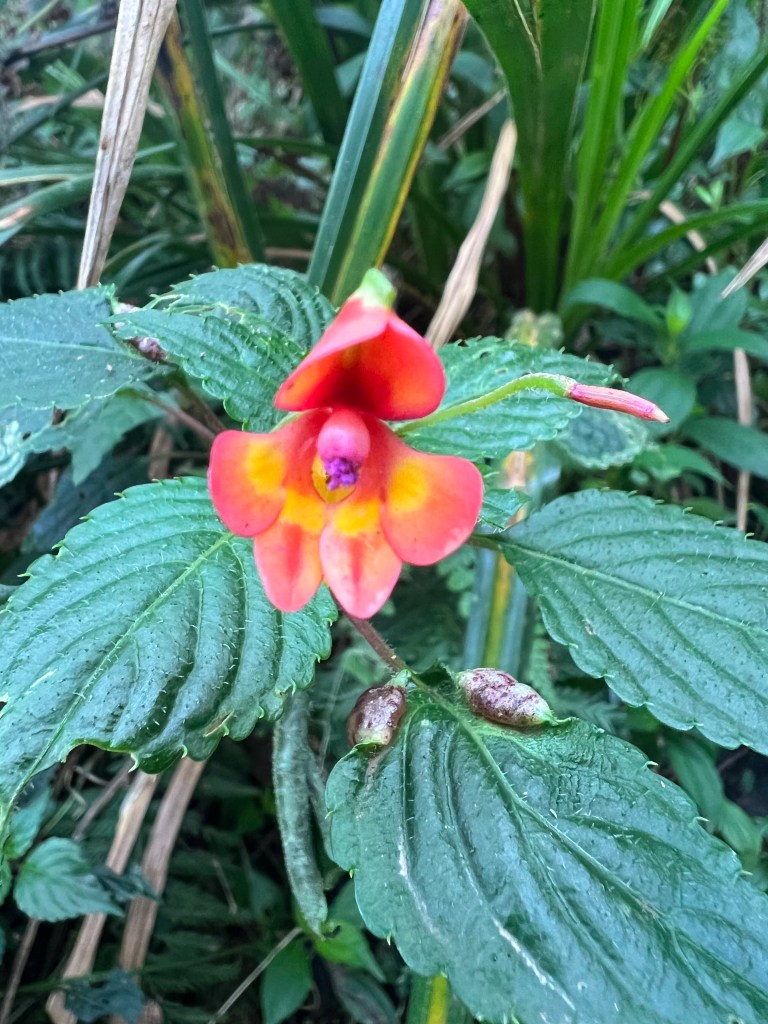
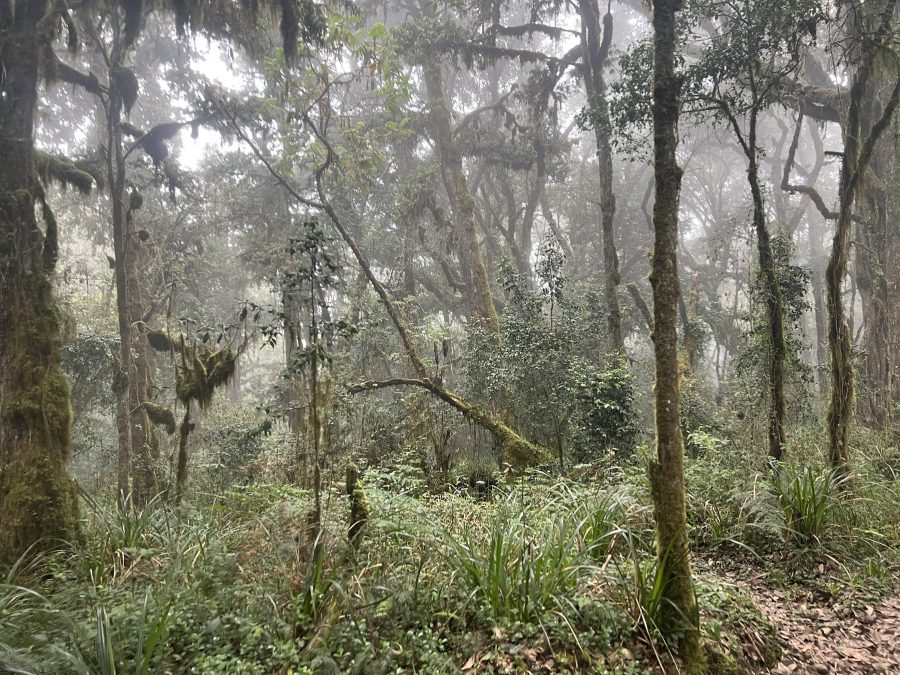
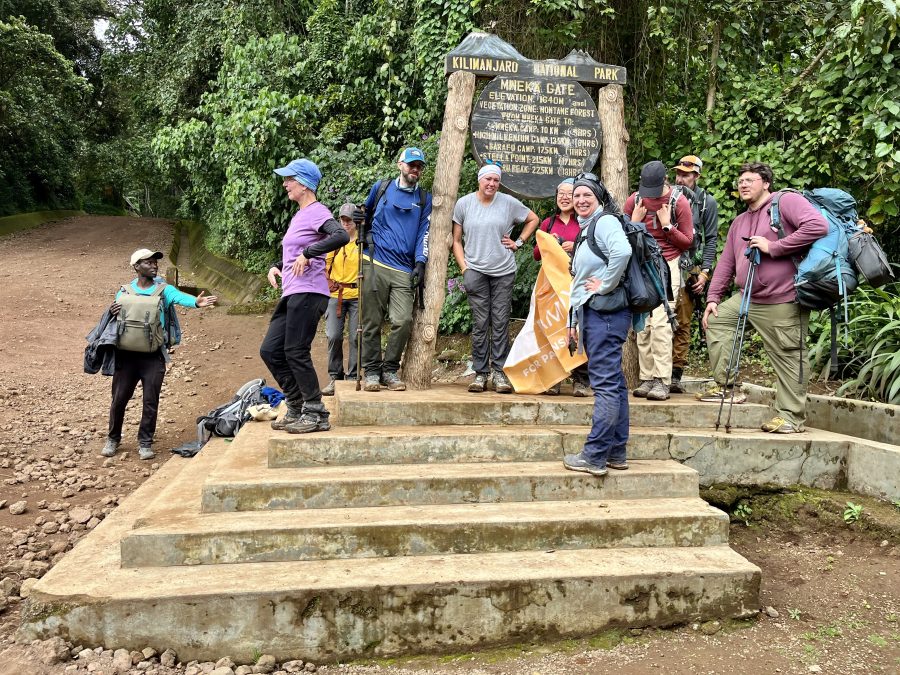
A few hours down the trail we came to Mweka Camp. We took a short break here and took another group photo beside the gatepost sign. By this time my pain had subsided and as we continued down the path I was doing good. We were now entering the rain forest. The vegetation had transitioned to dense, lush trees, shrubs, and flowers. The trail also transitioned to a steep, muddy, slick root laden path. Some of the group took spills onto the muddy terrain but no one got hurt. Once again, Matthew was by my side keeping me upright on the trail. We saw black and white colobus monkeys in the treetops. The colorful flowers along the way were very pretty and added a new dimension to the trail. It was also getting warmer and fortunately for us it did not rain so we remained dry. Eventually the trail became more of a gravel road. At last, after hiking about eight miles in six hours we came to the Mweka Gateway entrance of the Mt. Kilimanjaro National Park. This was the end of the trail. We had made it all in one piece. We were exhausted but very happy. As we stood at the gatepost sign to take our last group picture, the crew sang one more time the Kilimanjaro song. I was so ecstatic that I was actually able to get a little move in my body as I sort of swayed to the tune. There were a few concessions available and some of the group got sodas, beer, snacks, or souvenirs. Before going inside the building to register our accomplishment officially with the National Park Service, the crew washed and scrubbed our muddy boots. Then we logged our names into a book of records that would keep our accomplishment in perpetuity.
Mweka camp gatepost two hours into the last legLaura on the rain forest trailDense vegetation in the rain forestBlack and white Colobus monkeyMweka entrance gatepost
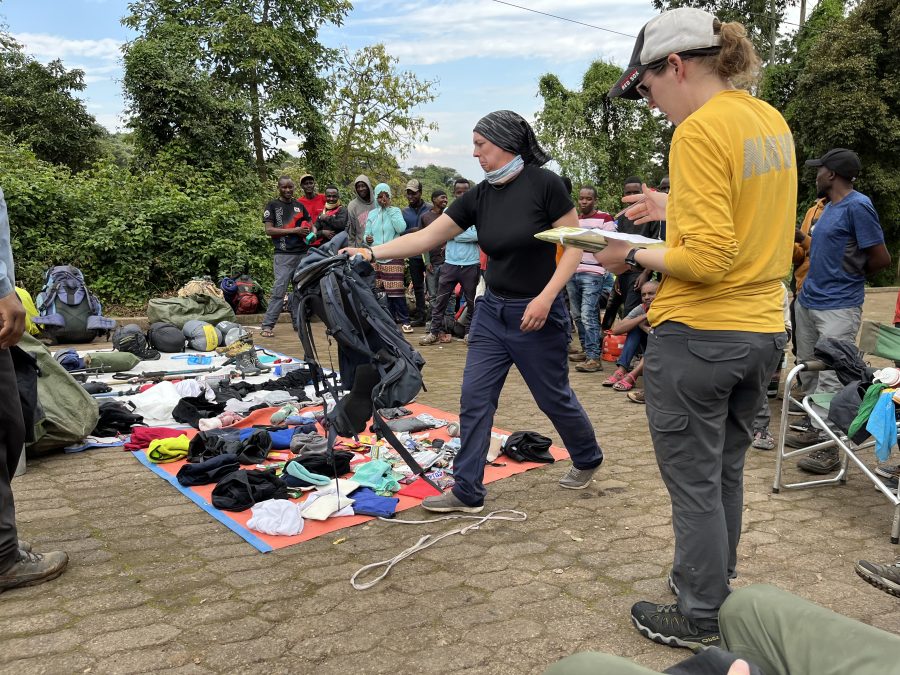
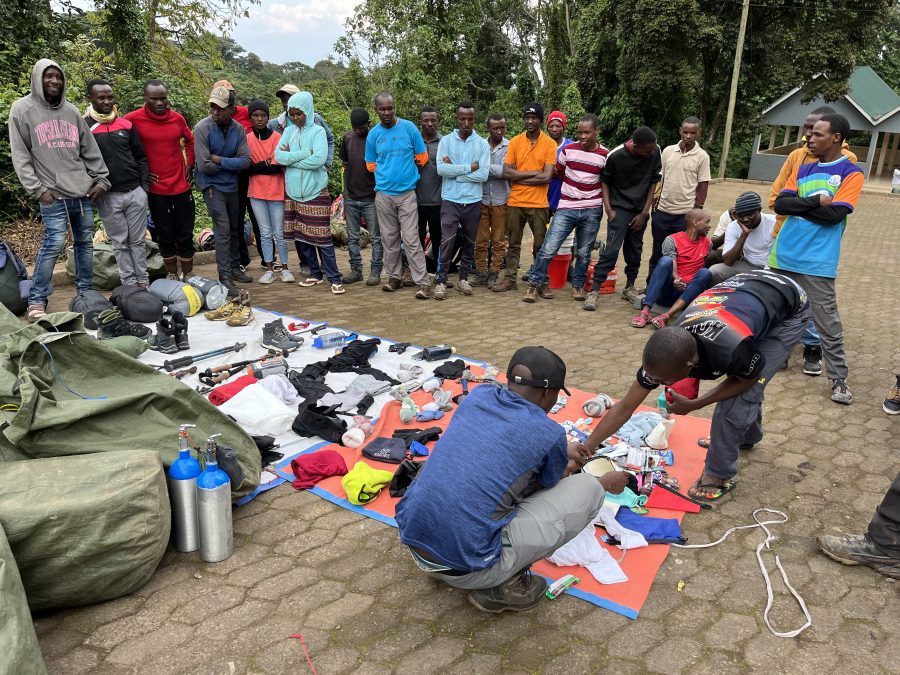
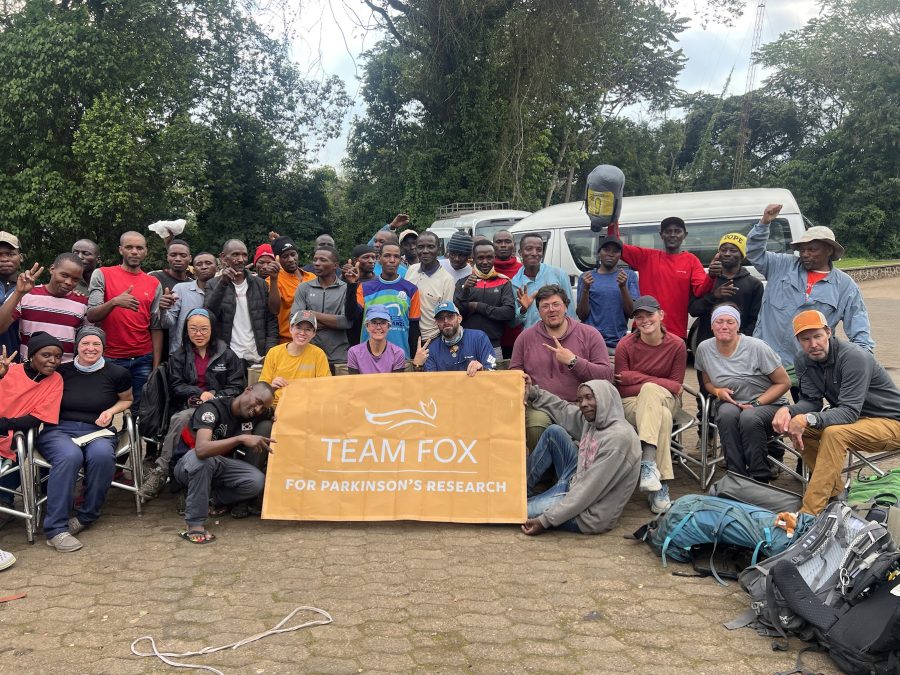
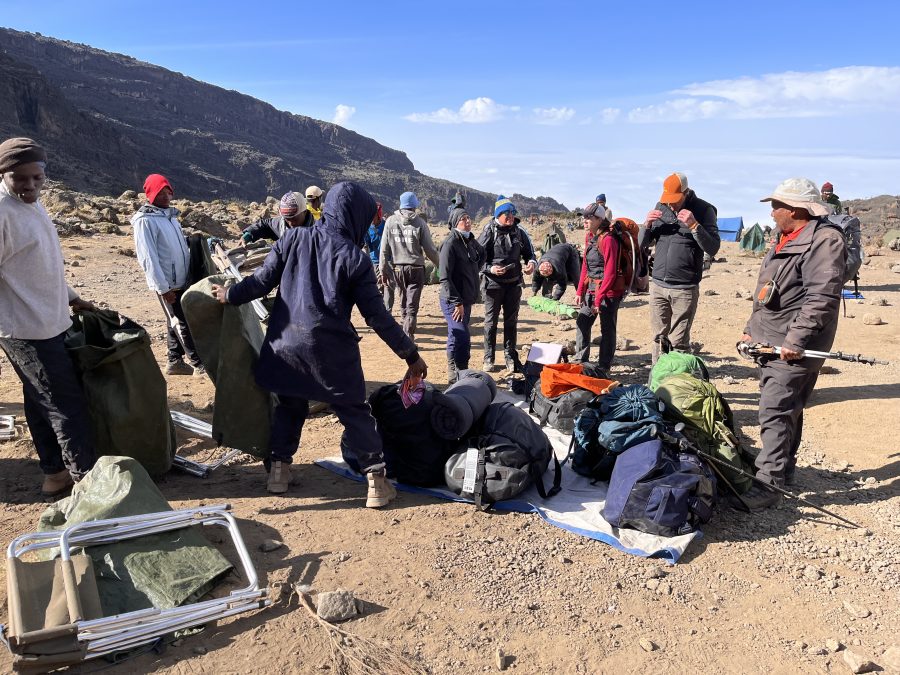
Before we left the area, we had a tipping ceremony. This is where we gave tips to those who had served us so diligently throughout the entire week we were on the mountain. It is hard to describe how it felt to have these men and women work so hard to take care of our every need and desire with such respect and genuine kindness. To say I felt humbled and honored seems inadequate. We had decided collectively ahead how much we would leave each person. Laura prepared a speech that she read to the crew telling them about our mission with the Michael J Fox Foundation. She told them how four of us actually had PD and the other five were hiking in honor or memory of a loved one. She thanked them for their devoted service to us. Then she read the list of how much each crew member would receive from us. The smiles and applause in response to their awarded monetary amount was very touching. Then, we spread a tarp on the ground where we put items of clothing or gear that we were willing to leave behind for our crew to keep. There are no mountaineering shops in Tanzania and even if there were most of them could not afford to buy the necessary items. The porters make about $10.00/day while the guides make $15.00-$20.00 a day. They are very grateful for whatever hikers choose to leave behind as that is how they obtain the necessary clothing and gear for themselves. Some in the group left almost everything they brought for the trip declaring that they would never camp again. Many left their sleeping bags, boots, jackets, poles, and various clothing items. The crew members got to choose an item one at a time until most of the major items had been distributed. It has been very rewarding to see pictures of some of our crew wearing some of the items left by our group. It was especially wonderful to see one of the women crew wearing Jo’s jacket with the comment that now she was able to stay warm. At the end of this post, I will leave a GoFund me account Jo started to help certain crew members meet some of their goals and an Amazon shopping list for items they need. I invite you to participate in giving this Christmas by including our wonderful crew on your list. The last group picture was of us with our crew. Then we said goodbye to these individuals who had impacted our lives in a profound way and who will never be forgotten.
Laura giving her speech Tarp with what we left behind for the crewThe whole group
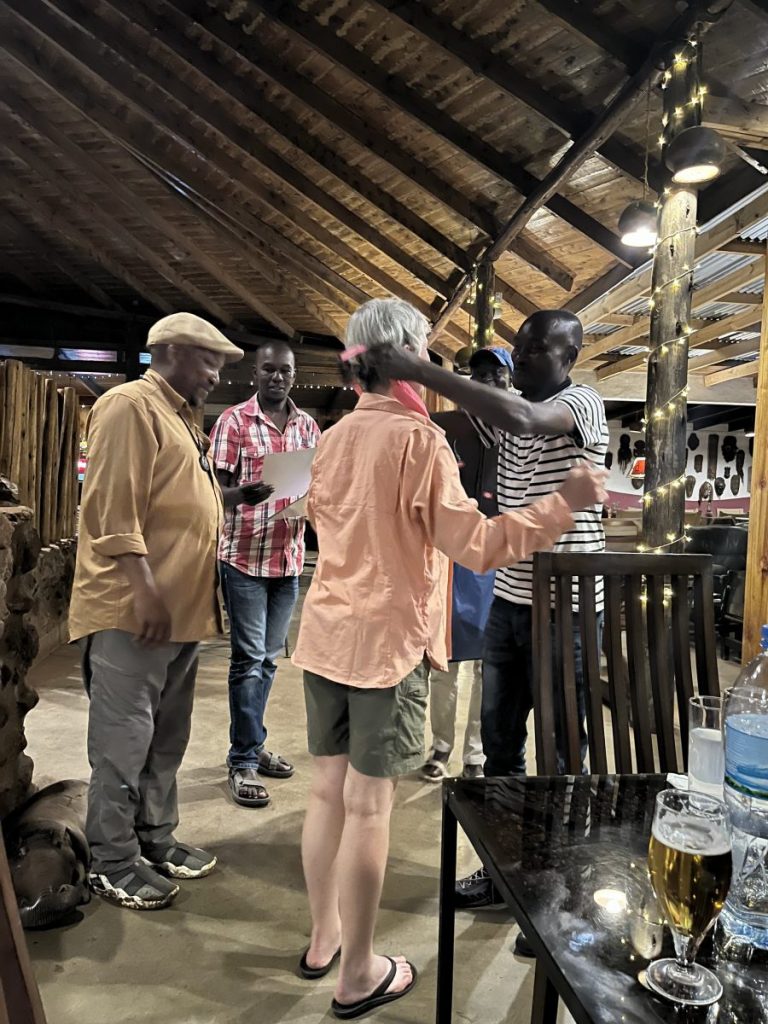
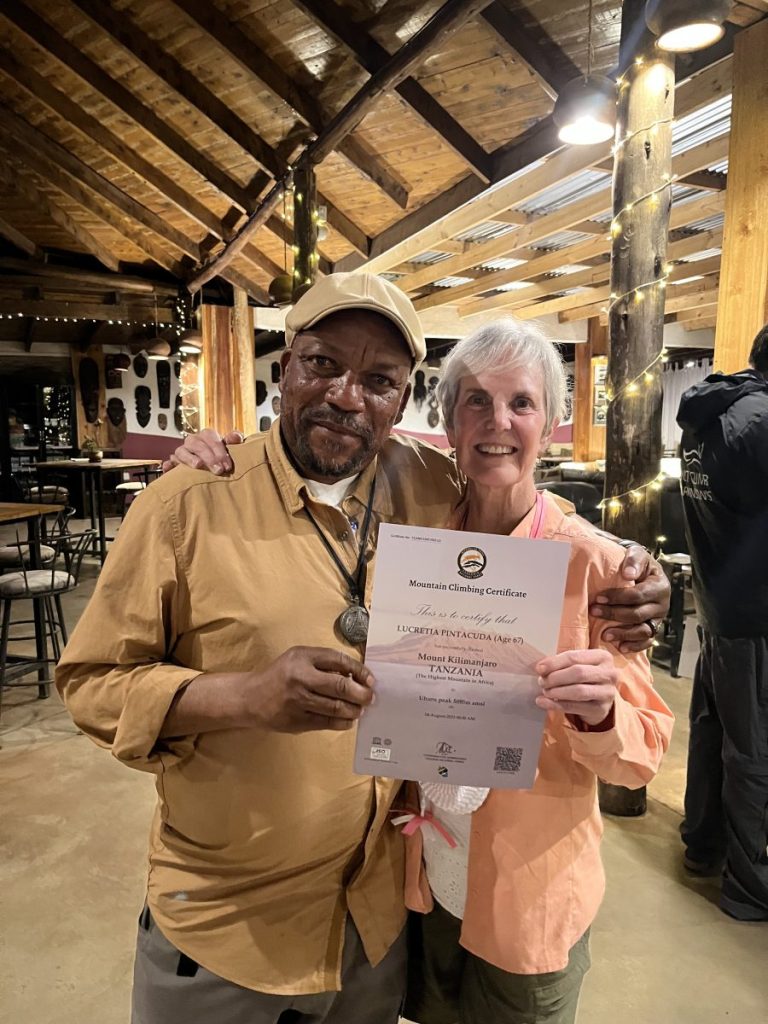
The bus ride back to Moshi didn’t take as long as the ride out had taken as we were departing from a gate that was closer to Moshi. Once there, we made a stop at a few ATMs to get cash for some shopping and other needs for the remainder of the trip. Next stop was a restaurant for a hot meal. We had eaten well on the trail, but this meal was really good and satisfying especially since I hadn’t eaten much for well over a day at this point. When we checked into our hotel that night all I cared about was a hot shower, flush toilet and traditional bed with sheets and blankets. It was a wonderful night after the best shower I have had in many years. After a week of not shampooing my hair the experience was pure pleasure. The next morning, we enjoyed a great buffet breakfast with all the traditional items one would expect at any place back home. Then some of us were off for some souvenir shopping. I spent that afternoon relaxing around the pool and dining area of the hotel in the company of some of the others from our group. Dinner that night was a grand event with a sumptuous buffet meal. Then Abel and the three other guides had an award ceremony where we were given our official summit document. There were speeches made, cheers and hoorays shouted out and lots of applause. Each of us got our certificate plus a locally made sash placed around our neck. I was the oldest climber so got my award first. The others were awarded in order of oldest to youngest. Mark Kohus, Jo Simmons, Kristen Gillan, Justin Fields, Laura Aldrich, Connie Qian, Alex DiLalla, and Betty Thomason all got their certificate and sash with pride of a grand accomplishment. Then there were pictures taken, hugs given, tears shed, and goodbyes said. I was up by 5:00 a.m. the next morning to leave for my long flight back home. I rode with Connie to the airport where we said goodbye and then I was off to be back in the air and airports for most of two days. Jo and I had one more opportunity for our paths to cross as we had about 2 hours in Doha, Qatar with overlapping layovers. We hugged and cried as we said goodbye knowing we would be BFFS and that it would not be long before our paths would cross again.
January places sash around my neckAbel and me with my official certificate
I arrived at the Asheville airport alone, very weary, a bit overwhelmed and ready to sleep in my own bed. My husband Jay was there to welcome me home and offer big congratulations for such an accomplishment. The next two days were spent mostly in bed sleeping and resting. I am in touch with all eight of the other hikers and the four guides on our trek. We are planning to participate in other Fox Foundation fundraisers in the future and are also planning a reunion for one year to the day after reaching the summit. I remain in recovery mode and frequently look through pictures taken on our hike. It was an incredible, magnificent, remarkable, difficult, tiring, strenuous but forever unforgettable experience. I am very grateful to have gone on this life changing trip with the group of hikers and the remarkable crew that accompanied me. My gratitude is grand for all who inspired, encouraged me, and generously contributed to my campaign for this journey. My story isn’t over yet though so look for more chapters in the future. I enjoy reading all the comments left on this blog so thanks to those who share their thoughts with me.
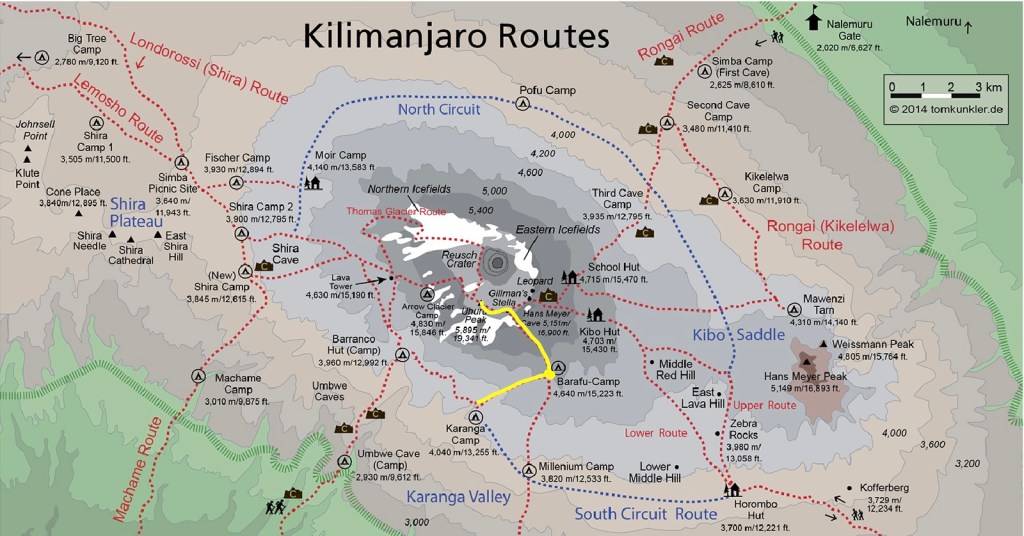
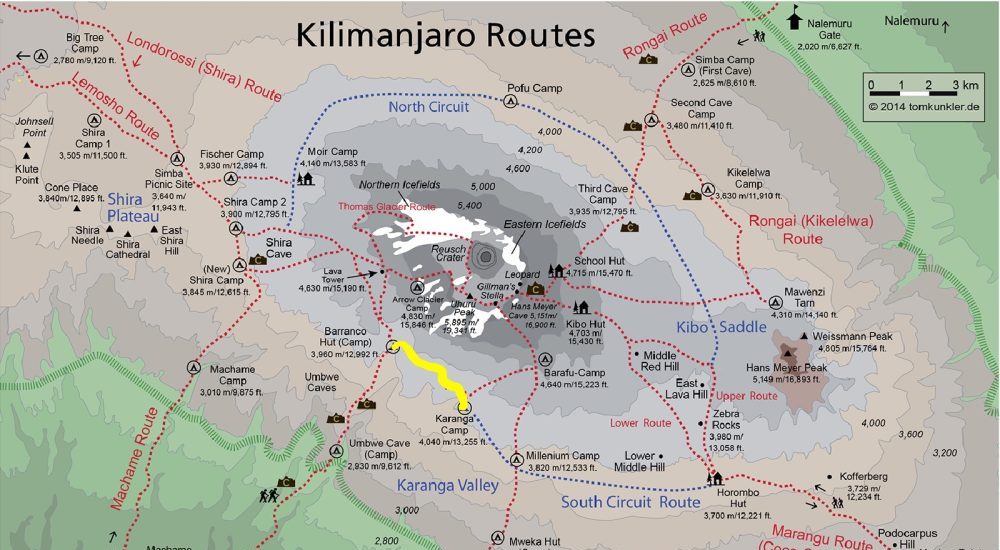
I woke up in the morning still tired from the day before even though we got to “sleep in” an extra half hour. We didn’t have such a long hike ahead of us to get to Barafu camp which was where we would start the final ascent to the summit of Mt. Kilimanjaro later that day. Karanga Camp is at 13,100 ft. elevation and we would climb to 15,300 ft. elevation to get to Barafu Camp. There we would have lunch and then rest for the afternoon and evening til 10:30 that night. Abel told us that he usually let his groups sleep til 11:30 to get ready to start the climb at midnight but since we were slow we would need to get an earlier start.
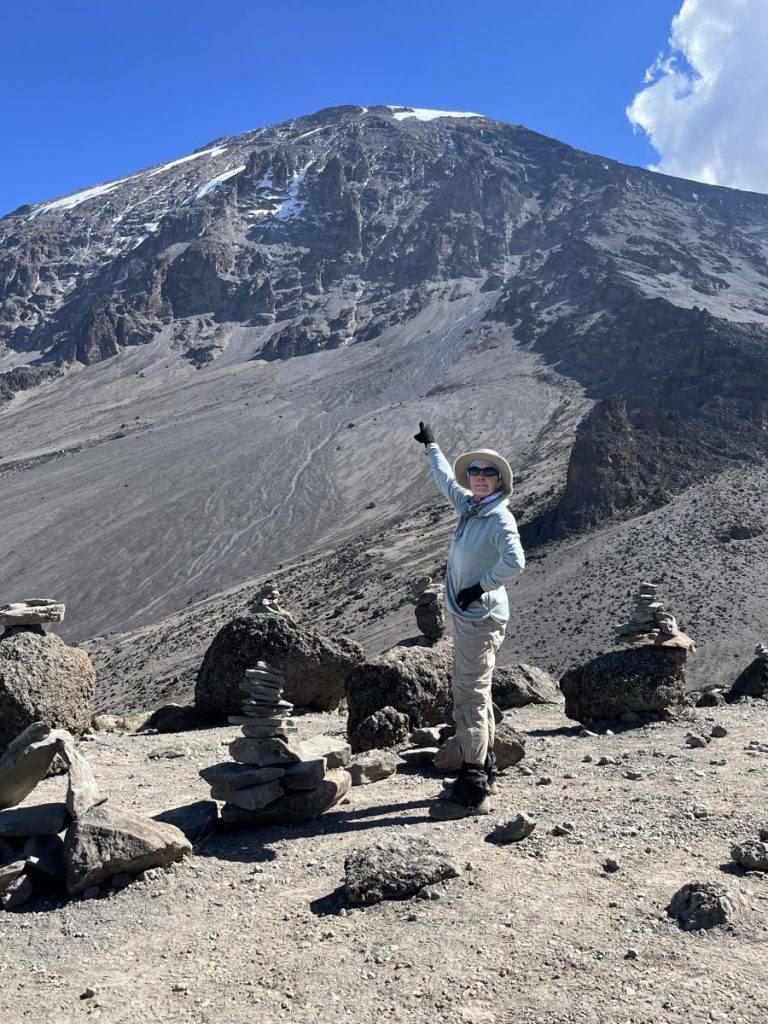
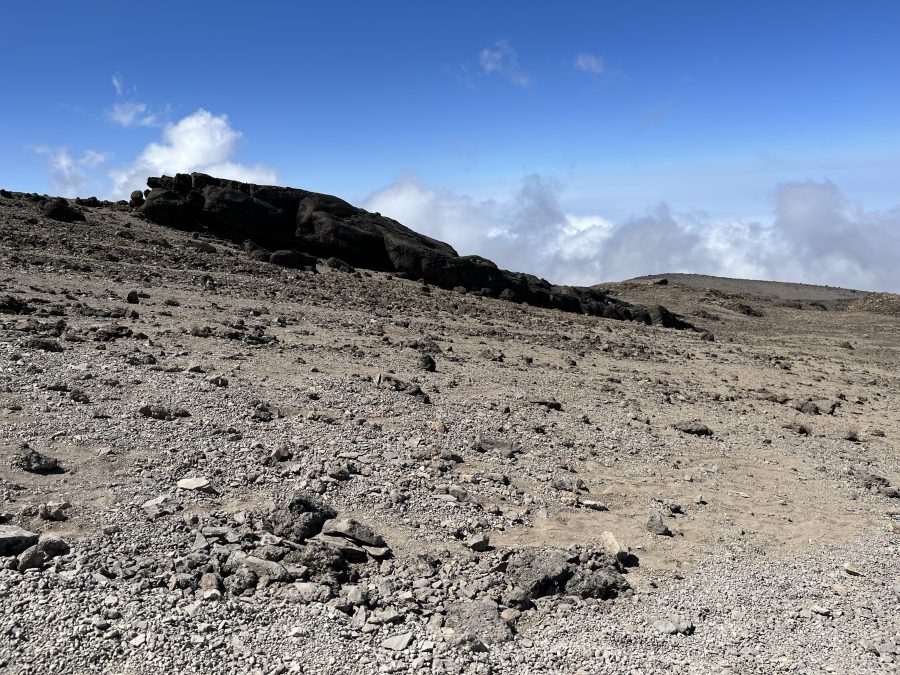
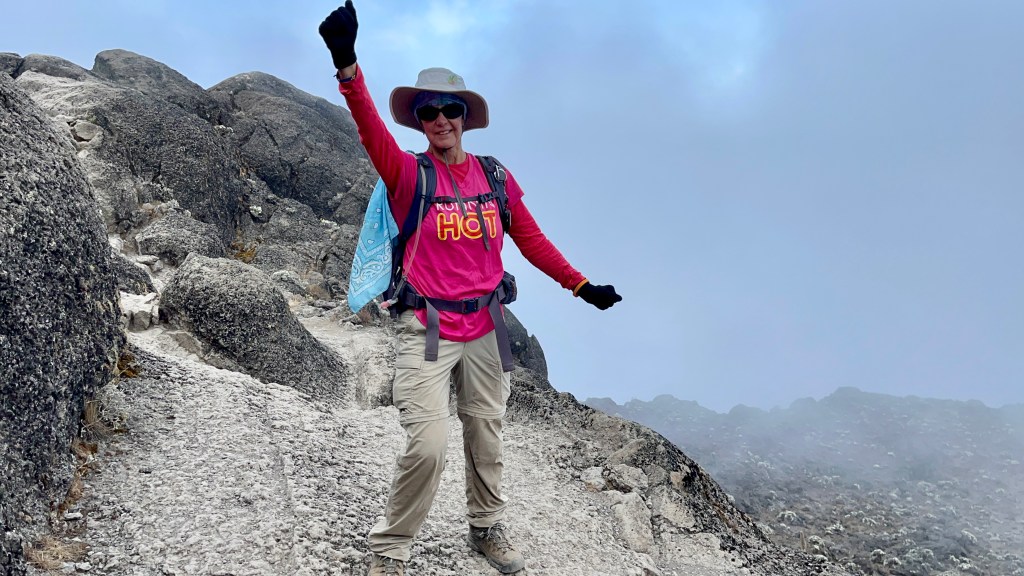
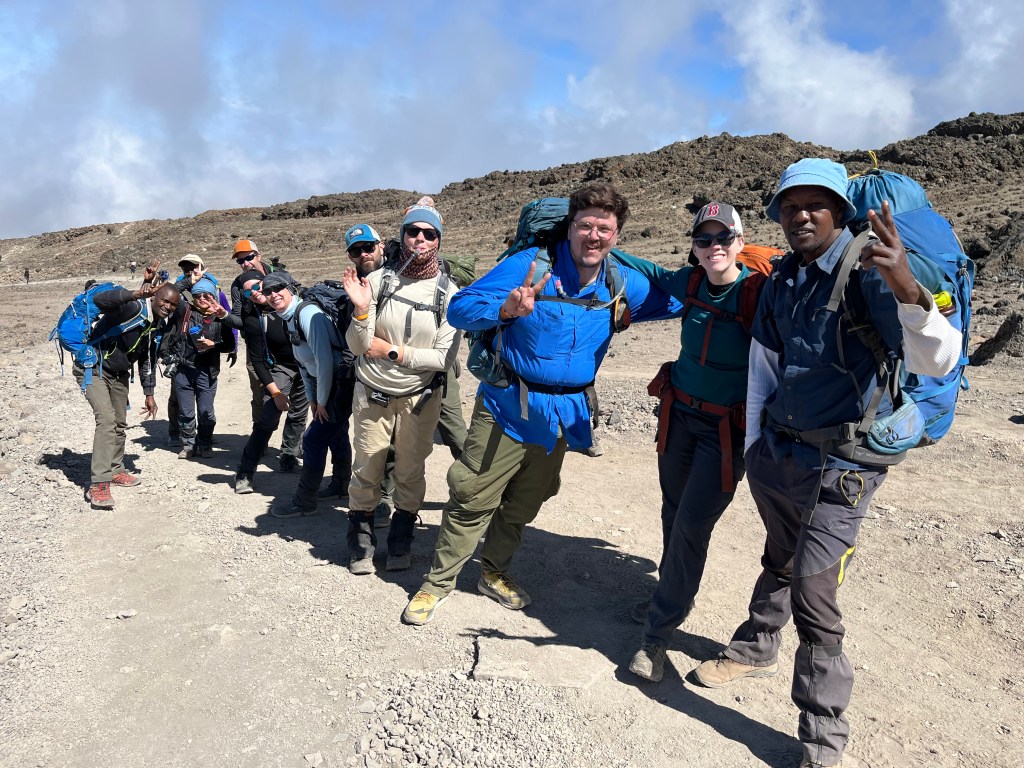
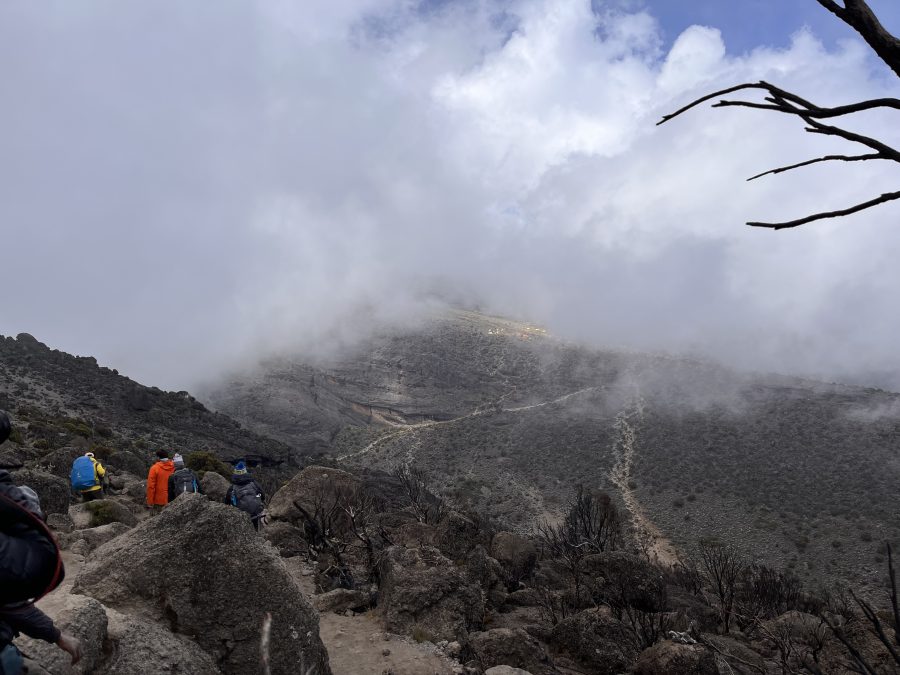
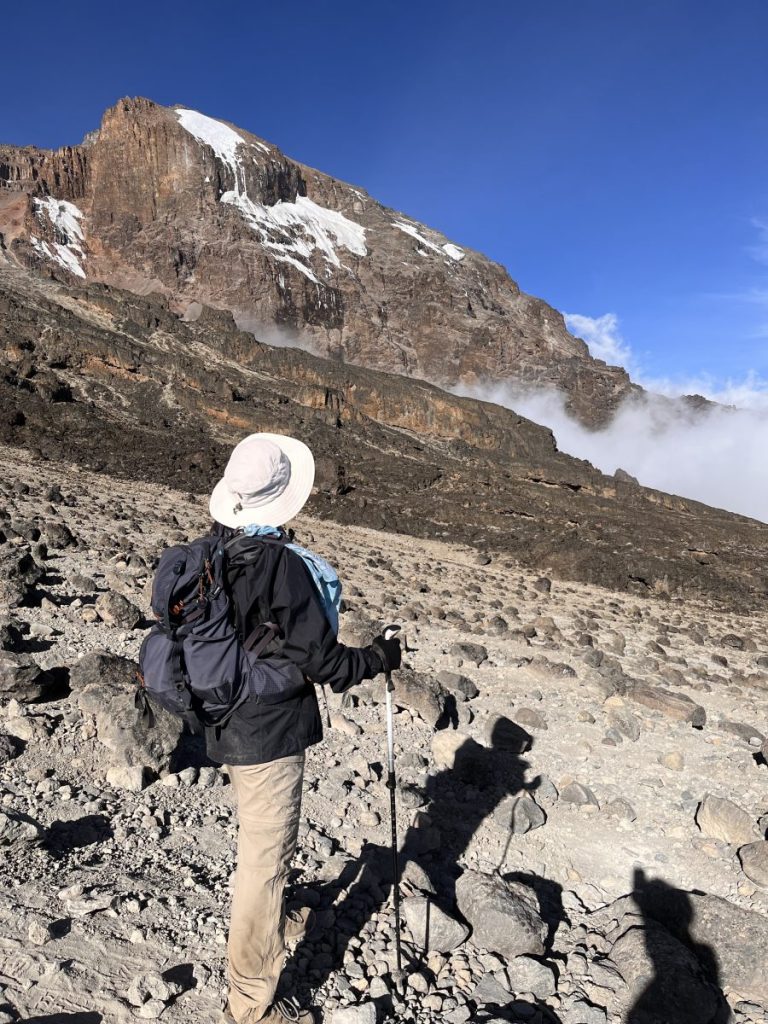
As we got on the trail, the mist of the early morning evaporated into a beautiful cloudless blue sky. The chilly air warmed up so we could shed our heavier jackets. There was a breeze but not a strong wind. The landscape of the trail was stern, rocky, barren, forsaken terrain that did not support much animal or plant life. This was definitely the alpine desert climate zone. We could see the top of Kibo peak off to the side of the trail on various stretches of the path. This sight was a reminder of our goal and encouraged us to keep going forward. At 13,000 ft. climbing to 15,000 ft. every step was an effort and every breath seemed like I was gasping for my last. We trudged on at a snail’s pace and took frequent breaks to hydrate and fuel our bodies. We didn’t engage in as much conversation while moving but during the breaks resumed our laughs and stories. At this point in the journey the nine of us had gotten to know each other in a way that often occurs when people band together for a mission and purpose that requires grit, determination, endurance, pain, and ultimate glory. We had learned about each other’s families, jobs, travels, hobbies, and connection to Parkinson’s Disease. We heard the trials that PD had brought to each of us and the difficulty and sorrow we had experienced. Each of us were determined to make a difference in the search for a cure. While our endeavor was to raise funds for research through the Michael J Fox Foundation, there was much more we wanted to accomplish here. We wanted to raise awareness about PD by telling our stories. We wanted to inspire others, not just with PD, but who face any adversity, to take charge of their destiny and get involved. For me personally, I wanted to show that people with PD can live full, vibrant lives. Hey, I have PD but I just climbed Mt. Kilimanjaro thus demonstrating a metaphor for facing the challenges of life. In a few days I had a bond with eight people plus our guides and spanning a 50-year age difference that under normal circumstances might take years to form.
Pointing to the peakCrocodile Rock
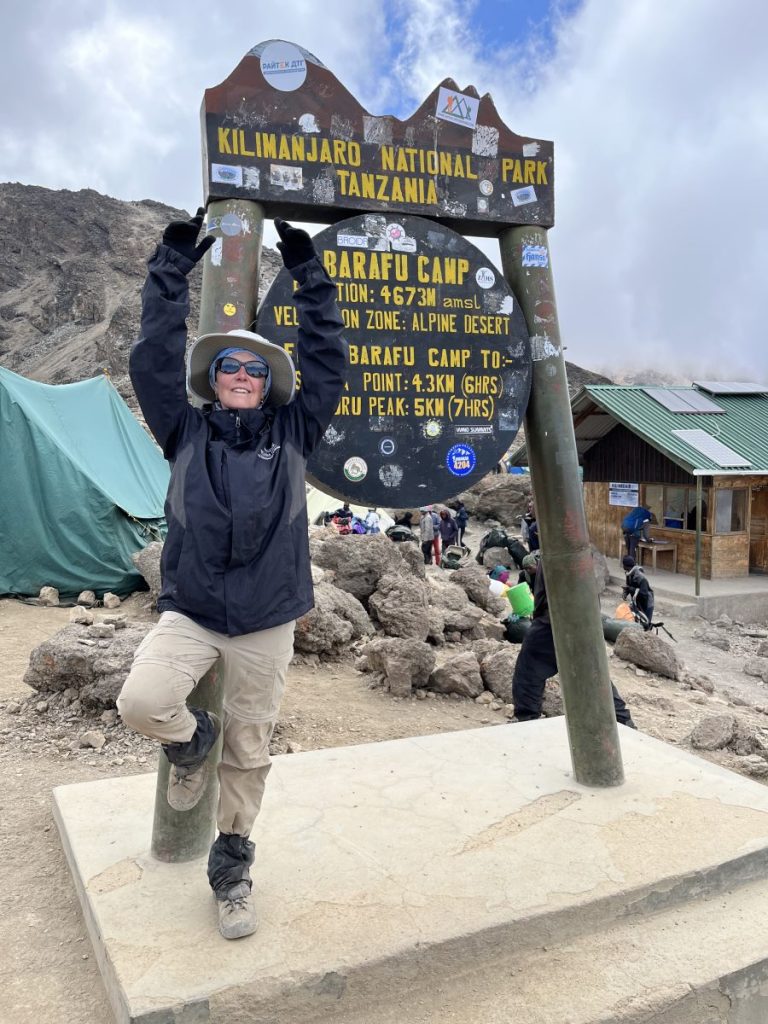
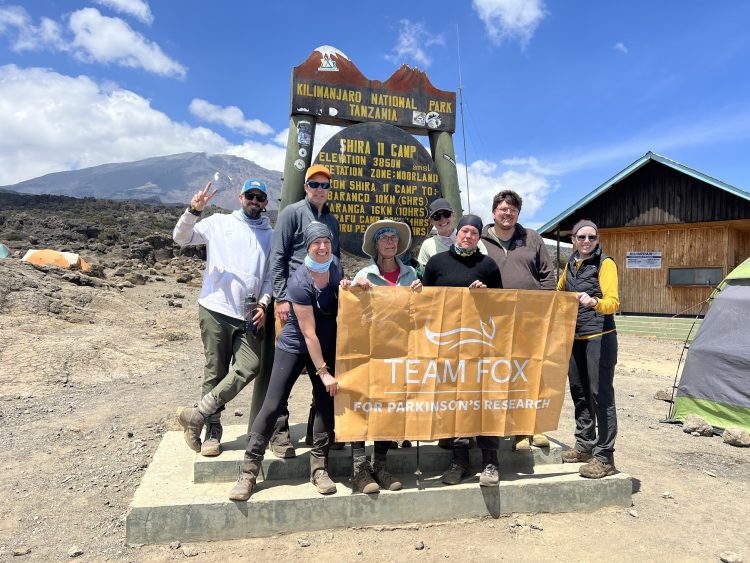
We arrived at the Barafu Camp in the early afternoon. After shedding our daypacks, we went farther up the path to the gate post for the obligatory group picture. While it wasn’t that far up to the gate post from our camp, at 15,300 ft. it felt like a struggle to get there. Back at camp, we spread out our sleeping bag and mat in our tent before lunch. Abel came to our mess tent to give us our debriefing about how to prepare for the hike to the summit. We were to wear four pair of pants, two pair of socks, at least two long sleeve fleece shirts, a wool hat, warm gloves with hand warmers in them, a parka, and a bright head lamp. I told Abel that my leggings were still wet from when I rinsed them out on day two and thus I did not have four pair of pants to wear. He asked me to bring them to him. I know he sent them to the cook tent to have them dried over the stove. Later that day they were dry and ready to wear to the summit. I really don’t remember much about the rest of the afternoon so I must have gotten the rest and sleep needed for the final and certainly most difficult leg of this epic expedition.
My stance at the gate postBarafu Camp
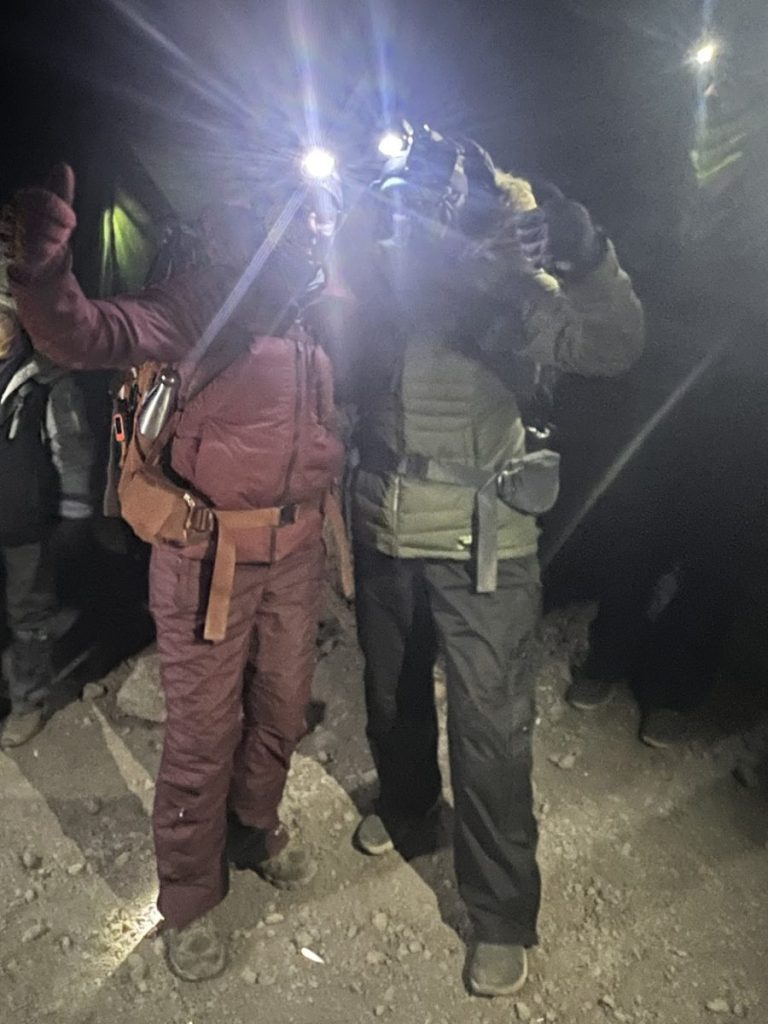
It was very dark and cold outside when 10:30 p.m. arrived that night. I started getting dressed for the climb but that was not an easy task. I struggled to pull my leggings over my long underwear, then my fleece pants over my leggings and finally the rain pants over the fleece pants. Next came putting on the top layers and then the socks. I had to loosen the laces on my boots to accommodate the extra socks and toe warmers I put in each boot. Then, I put on the wool beanie hat and a head band that went over my ears on top of the hat. I put on my bright blue parka and got out the neoprene face mask from my snow skiing days. I had recharged the batteries on my gloves but must have left them on during the afternoon as the batteries to the gloves were dead. Having cold hands and fingers is very difficult for me as they freeze up so that I can barely move them. I could only hope the gloves would be warm enough without the batteries to provide extra warmth. Once I had all my clothes on I had to get my boots on. Needless to say, I was the last one to the table for the meal needed to provide energy as we made the assault on Kilimanjaro. I was frustrated! I still needed help to get my boot laces tied and my gaiters on. So, I sat down and lost it. I fumed about how small the tents were and how difficult they had made my life on this trip. Everyone at the table quietly listened to my rant until I snapped out of it and said “enough whining”. It was time to get it in gear and do what needed to be done to reach that pinnacle. I grabbed a little food to eat from the table, gratefully accepted help getting my boots tied, the gaiters put around my ankles, opening the chemical warmers for my hands and feet, and my water bag filled. Jo let me use her extra head lamp as mine was not very bright. It was 11:30 p.m. on August 13 and we were ready to start the ascent of 4,000 ft. elevation in three miles to the top of the highest, free standing volcanic peak in the world.
Laura and Jo ready to go
It was a cold, crystal clear, moonless night as we lined up single file to start up the path. Able led the group and I was placed next in line with Matthew close behind me. As we started very pole, pole, or slowly, slowly up the trail I noted the brilliant stars above me with the constellations of Orion and the Big Dipper at the horizon so close I could reach out and touch them. The lights of the town of Moshi twinkled below in the valley. A single file line of head lamps from other groups stretched out before us going upward to the peak. The imagery was like I was ascending to Heaven with the earthly lights fading in the distance. It was very vivid and made me think of Jacob’s ladder. I felt the presence of a higher power reaching from above to connect with my soul in a very real and almost tangible way.
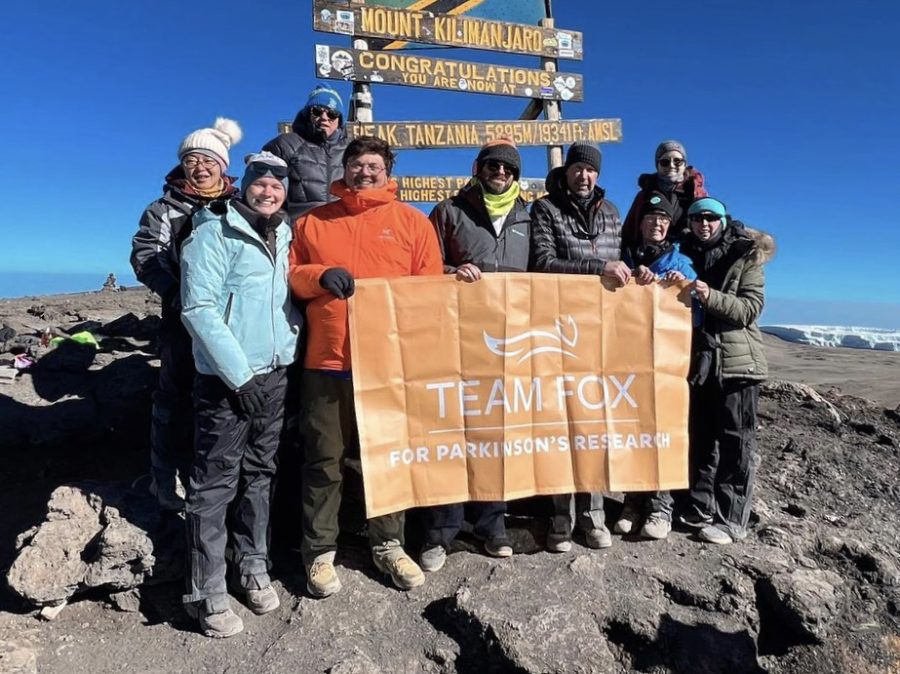
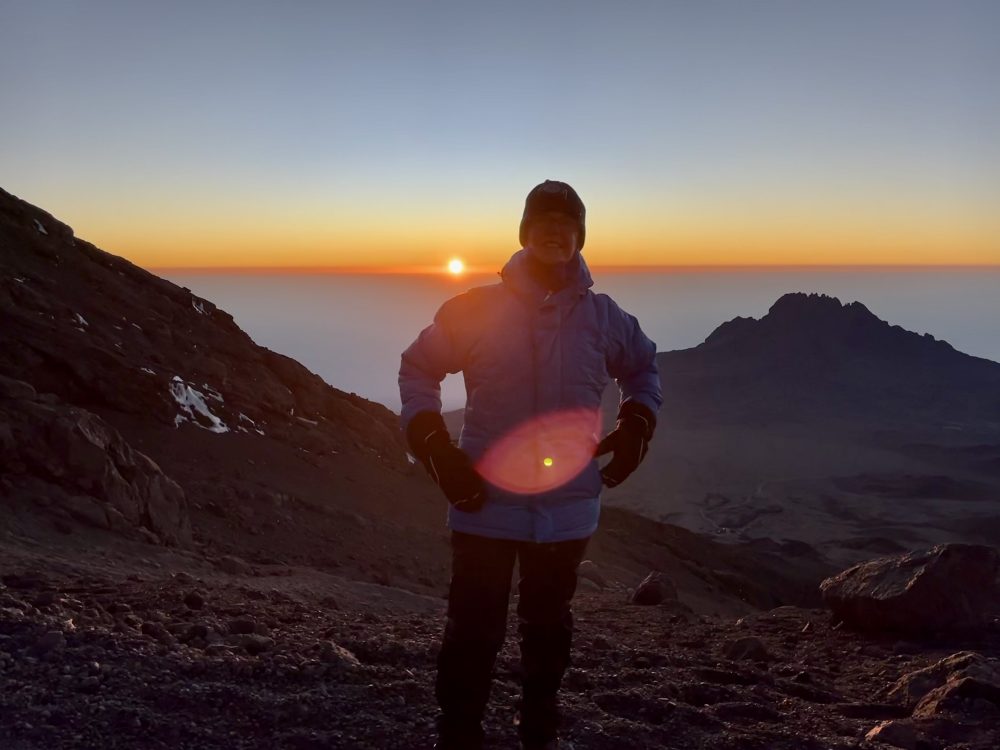
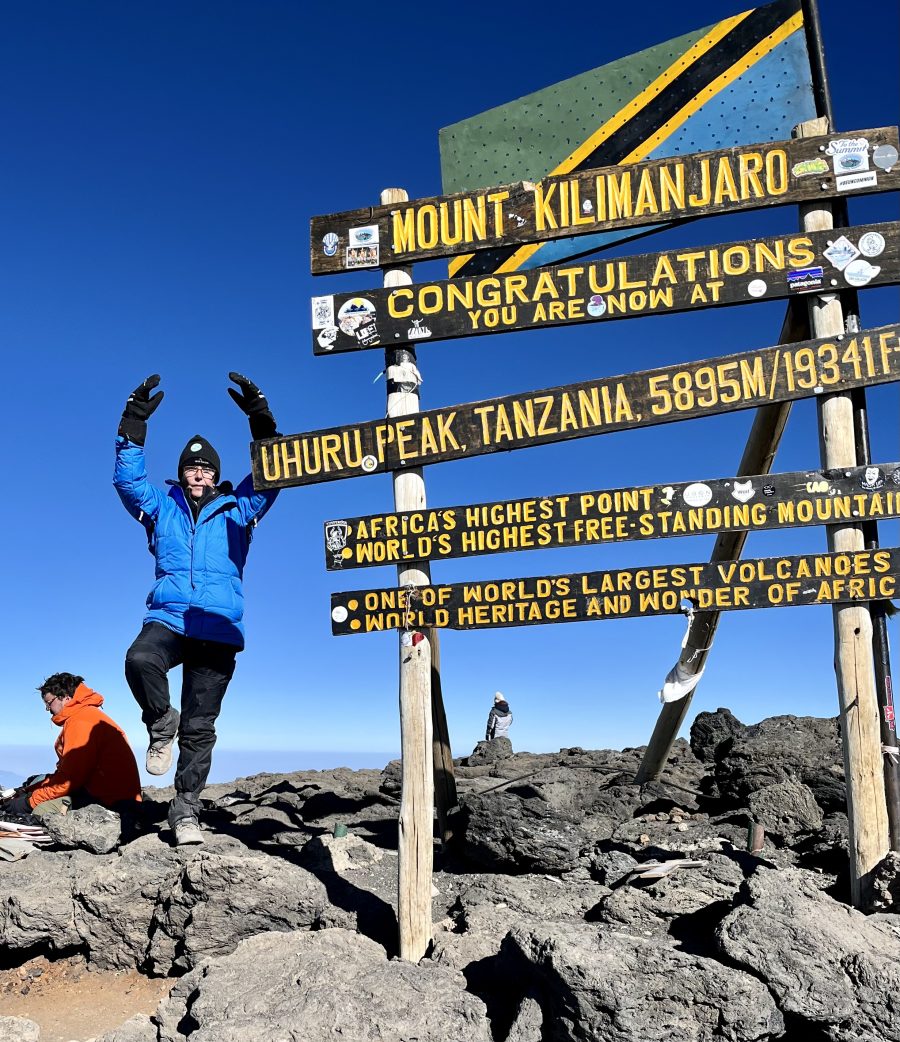
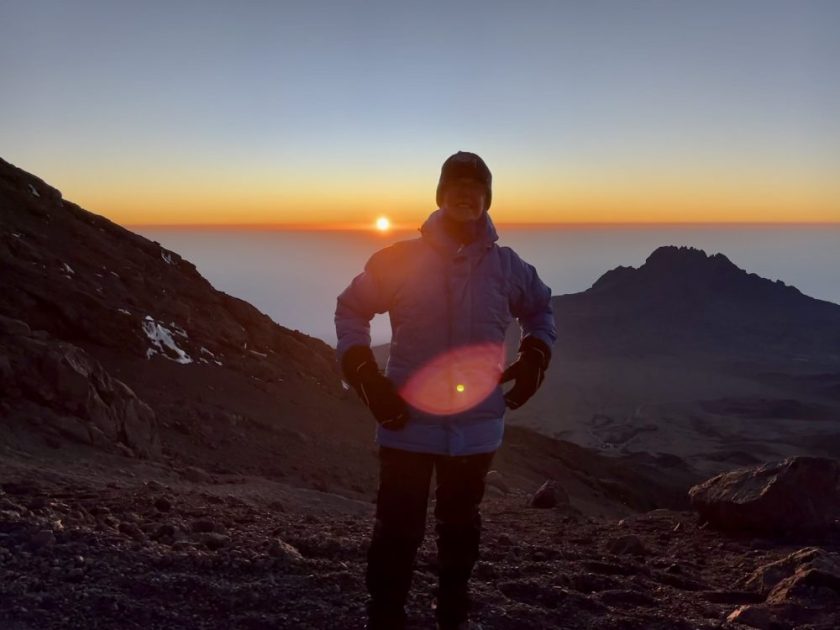
We made our way in silence for the most part at first. Then, Alex started having difficulty with his footing. We paused to see what he needed. It seemed that Alex was needing to redose his PD medication and this was undoubtedly more pronounced by the altitude. Abel moved Alex to the head of the line behind him. As we traveled upward, the lights of Moshi became dim, and the constellations moved across the sky. The headlamps ahead of us spaced out farther away so we seemed to be alone on the mountain. Others in our group were feeling the fatigue and effects of the altitude and demands of the trail such that they were not feeling well. I was snacking on my high energy gummies and gels to give me strength and doing okay. And then the first light of dawn appeared on the horizon. I was awestruck and determined to take it in. At first it was a hint of light and then a bright, glowing streak of orange across the longest horizon line I have ever seen. I could actually see the gentle curve of the earth that the view from 17,000 ft. elevation gives. I wanted to stay at that spot long enough to see the bright, glowing ball of the sun break through. After taking many pictures, we continued upward. It was bitterly cold at about zero degrees Fahrenheit, but the sun brought a welcome warmth for the rest of our ascent. There was some wind but not so strong that it made hiking difficult. It wasn’t long before we came to Stella’s Point, the first place on the rim of the crater along the trail. Matthew said we needed to keep going to get to Uhuru Peak as by this time the group had spread out and since we couldn’t stay very long at the high altitude, we needed to get there as a group not as individuals. It was about another hour of hiking along the rim to reach our destination. So, by putting one foot in front of the other, I trudged on still feeling good. The terrain was pure desolation with nothing but dry, volcanic space and gravel. Off to the southern side we could see the top of the ice and glaciers we had seen while traversing the path below for the past several days. The iconic sign was just ahead but every step took determination. And then, I was there. I was at the peak. I was at Uhuru Point. I was at 19,341 ft. elevation. I was there beside that iconic sign. I had made it on Tuesday morning August 14, 2023 at 8:30 in the morning after 9 hours of hiking through the night. This story will be continued in part 2 …
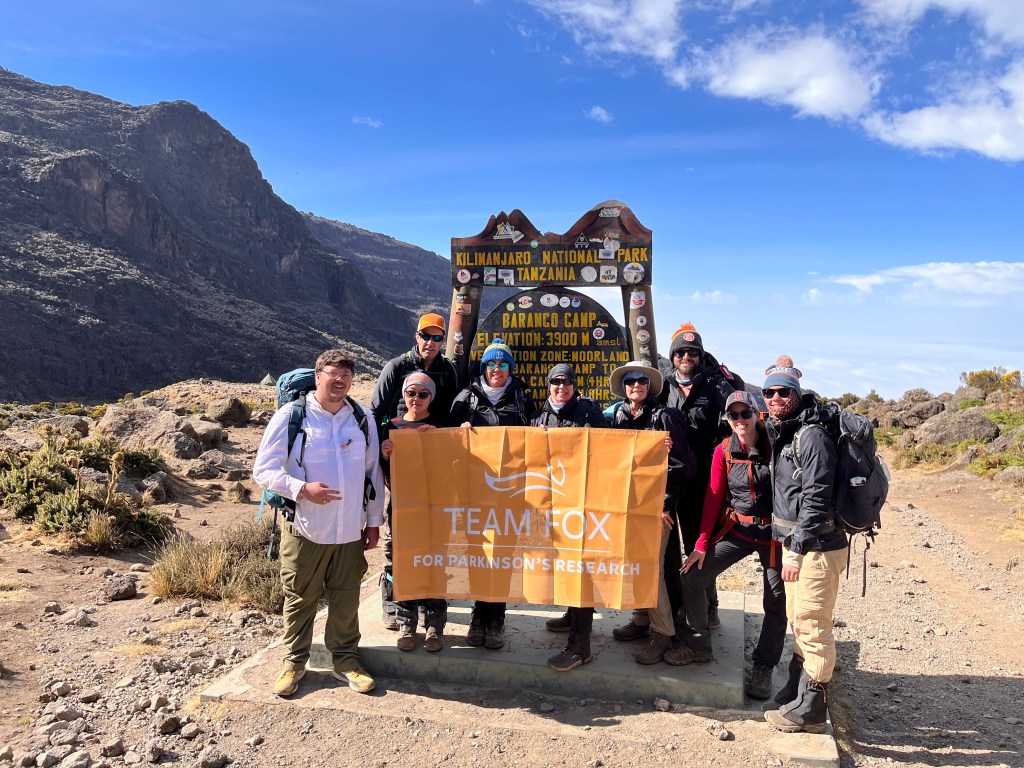
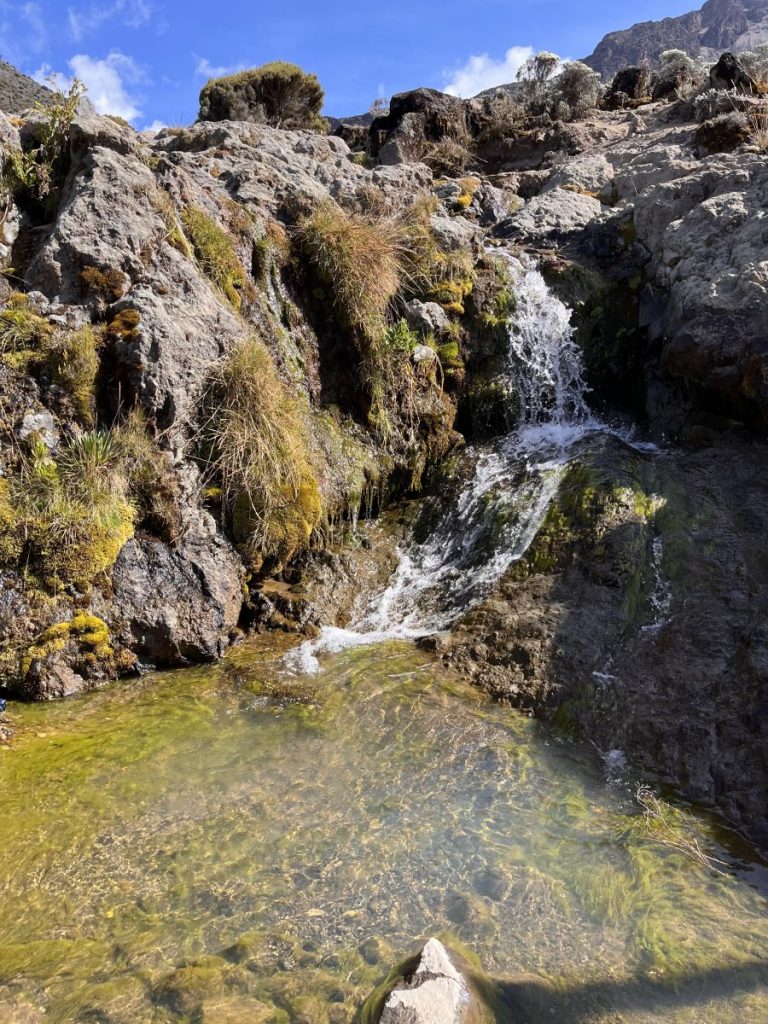
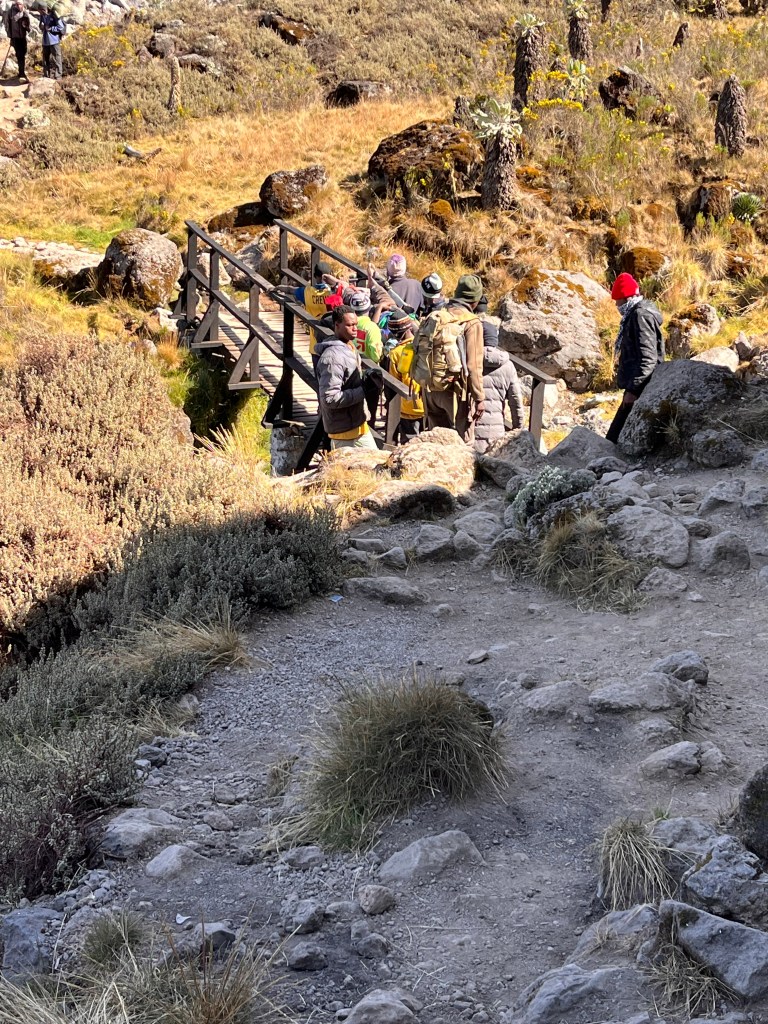
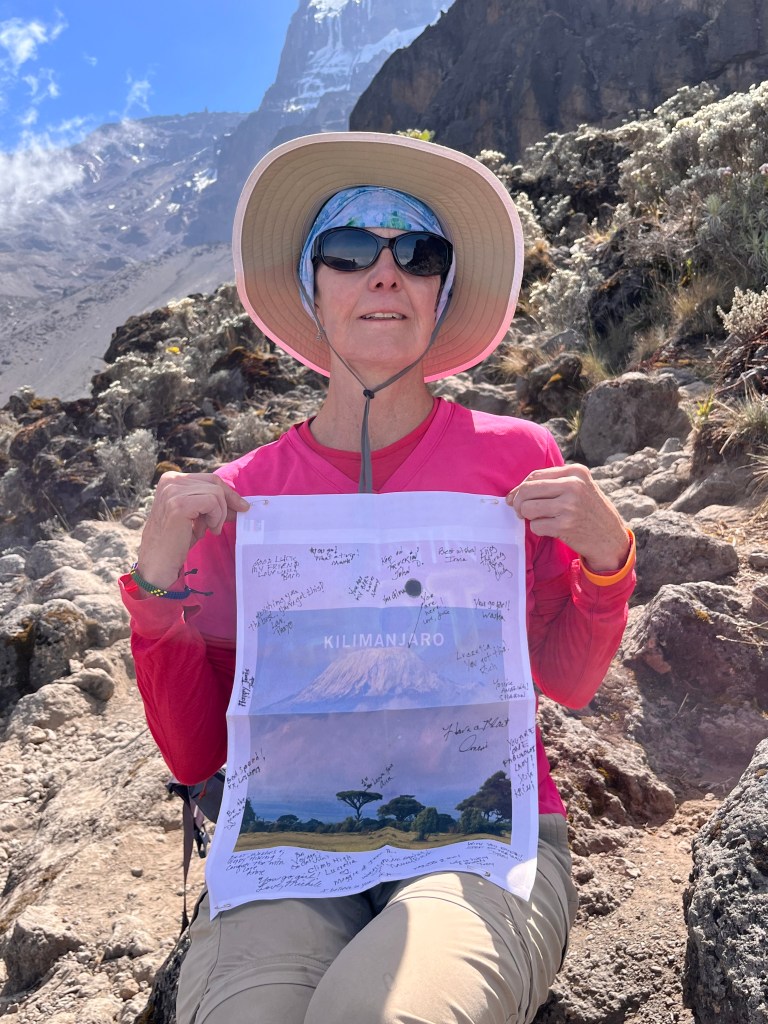
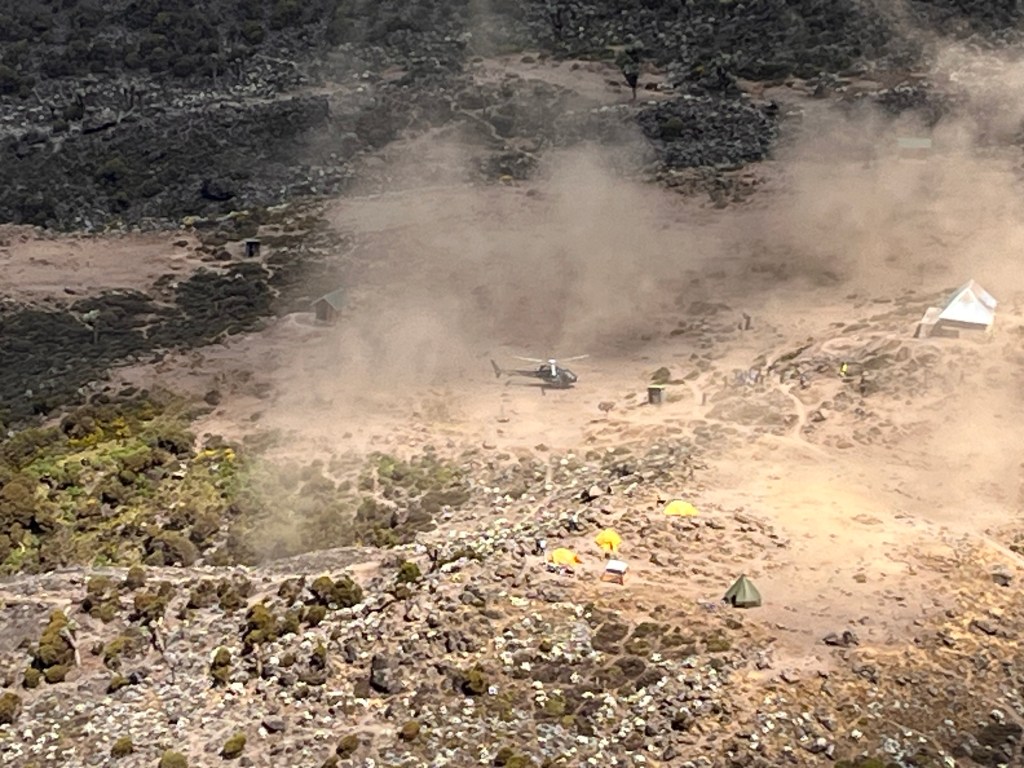
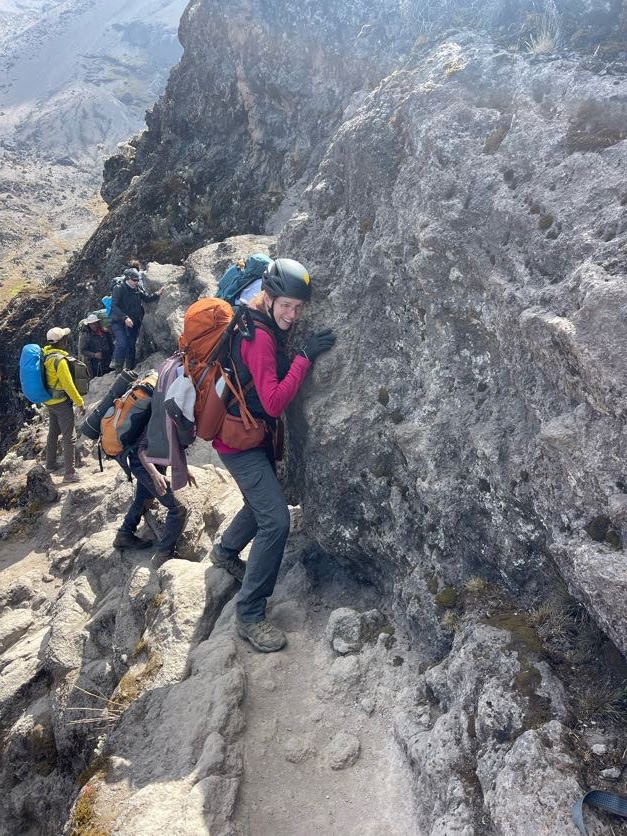
The morning came soon enough, and it was time to rise and shine and get going. We didn’t have as far to go on this day, and we weren’t making a big elevation change to the next camp but getting there would require some dramatic up and down segments on the way. To start, we would have to climb the famed Barranco wall which is a very steep zig zagging trail that would require using our hands to scramble in some areas. We would be trekking above 13,000 ft. which makes every step a big effort. We gathered at the gate post to get the group photo at the Barranco Camp before starting out and then began the hike. We crossed a bridge over a stream with a pretty waterfall and I could not miss taking a photo of this sight. Not far up the trail, we saw a group of crew members from a different group carrying a stretcher with a crew member lying on his back and being carried down the trail back to Barranco Camp. I could see one of his legs had a splint on it and knew he had injured it and would need to be helicopter lifted off the mountain. It was a stark moment of realization that there was real danger doing this expedition, not just to us but to the crew members who make every journey of many hikers possible. It was a reminder that there have been deaths trying to conquer the mountain and we needed to be careful and use caution. Ahead and looking up I could see the single file of hikers making their way up the wall and felt a mix of excitement and dread. I was so glad that Abel had assigned Matthew to guide my every foot placement and handhold as I knew he would keep me safe. I was the first in line on the steepest places and got to watch the others make the ascent. Once the group was up the steepest part I had a sense of great accomplishment and took a video of my exhilaration. It was here we saw the helicopter fly in, land, and pick up the injured man from the Barranco Camp down below. The next feat was to pass by the “kissing rock”. This is a very narrow spot where one must brush right up against a large protruding rock with the trail dropping off steeply on the other side. We literally kissed the rock as we slid by it’s hard surface. Not far from this place the trail leveled off and had a spot with large boulders great for resting and taking a snack or nature break. We could see the peak of Kilimanjaro also known as Kibo because that is the name of the highest of the three volcanic cones making up the mountain. The Shira peak on the western side creating the Shira plateau where we had come and the Mawenzi peak to the east are the other two cones. We were getting closer to our goal, and we could see the majestic peak. By this time in the trek, we were getting quite well acquainted with our fellow teammates. We shared stories of our life, our families, our current situations, our connection to Parkinson’s disease and our motivation for signing up for this epic trip. There were moments of laughter, sadness, happiness, and revelations of hopes and fears yet ahead in our lives. The mountain is barren and desolate, and it was hard to hide or have privacy both physically and emotionally such that I felt exposed often with the loss of dignity and had to trust my fellow hikers to respect boundaries and secrets revealed. I know that for each of us there are things that will stay on the mountain forever and thus the bonds of friendship and camaraderie got stronger with each day and each advancement along the way.
Barranco Camp Gate Postthe waterfallInjured crew memberMy dance of accomplishmentBanner I carried with me from my hikersthe helicopter airliftthe kissing rockslow progress
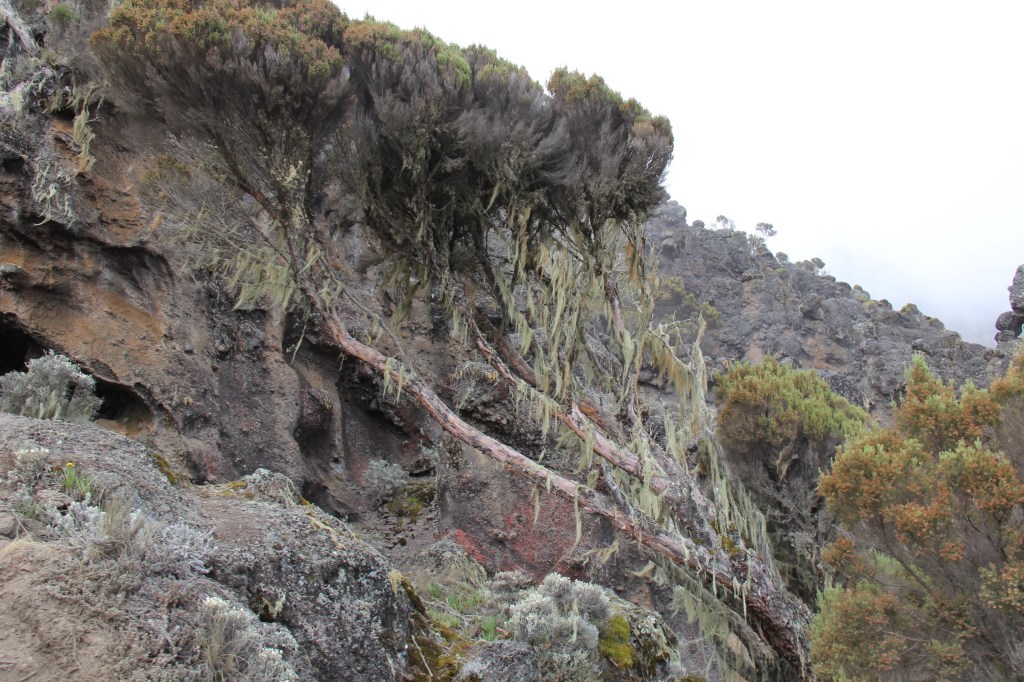
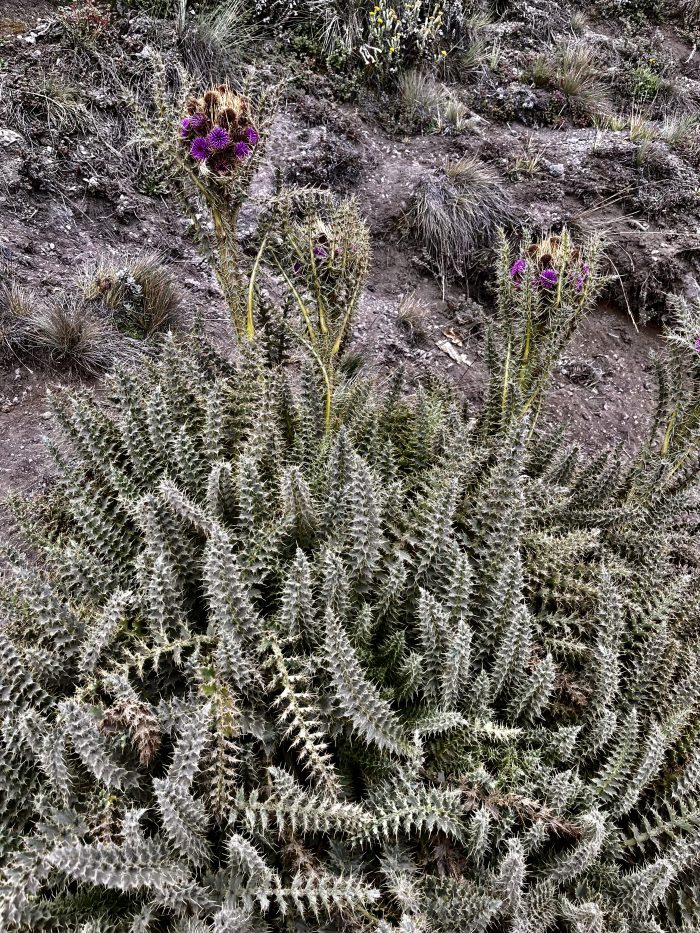
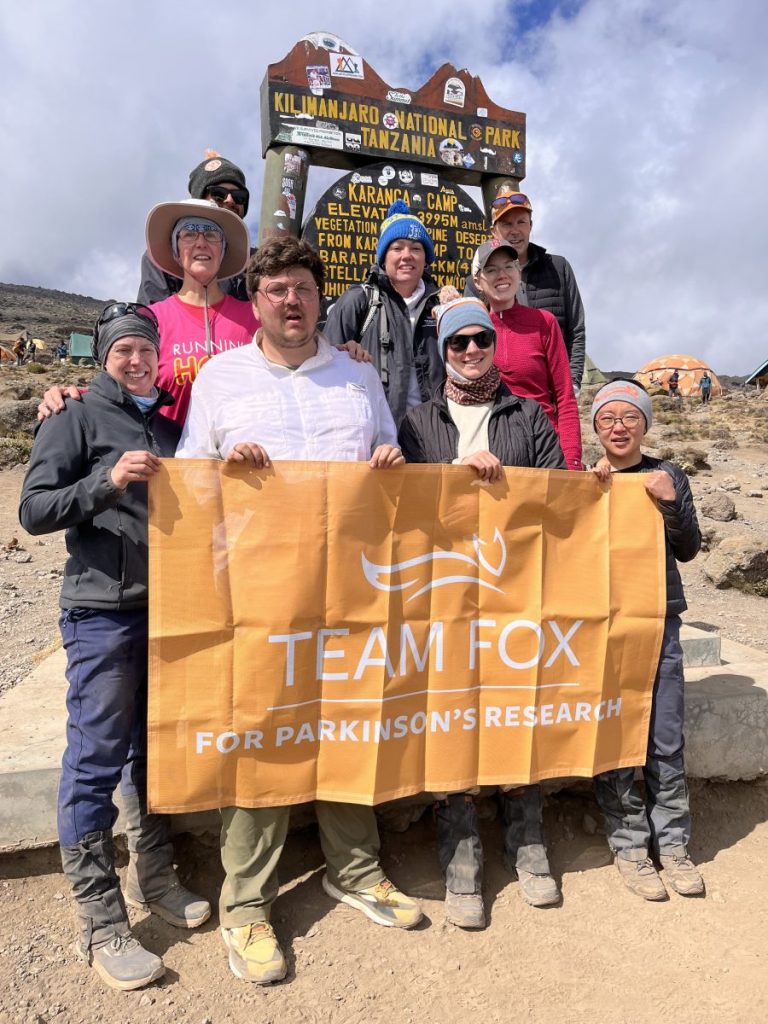
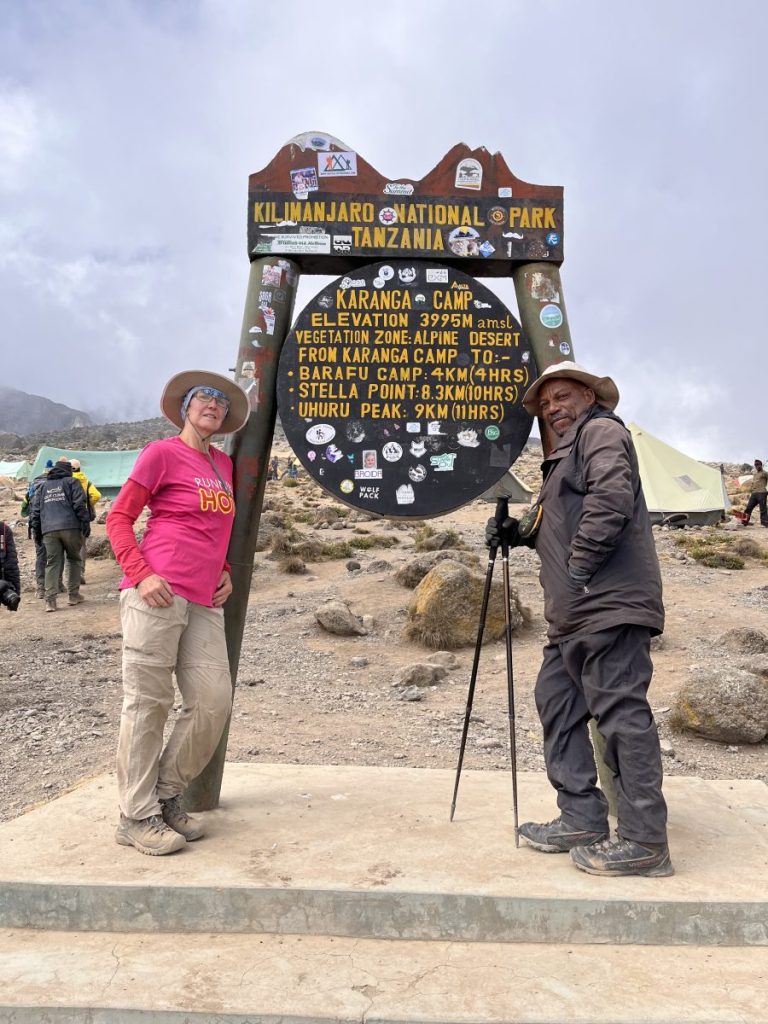
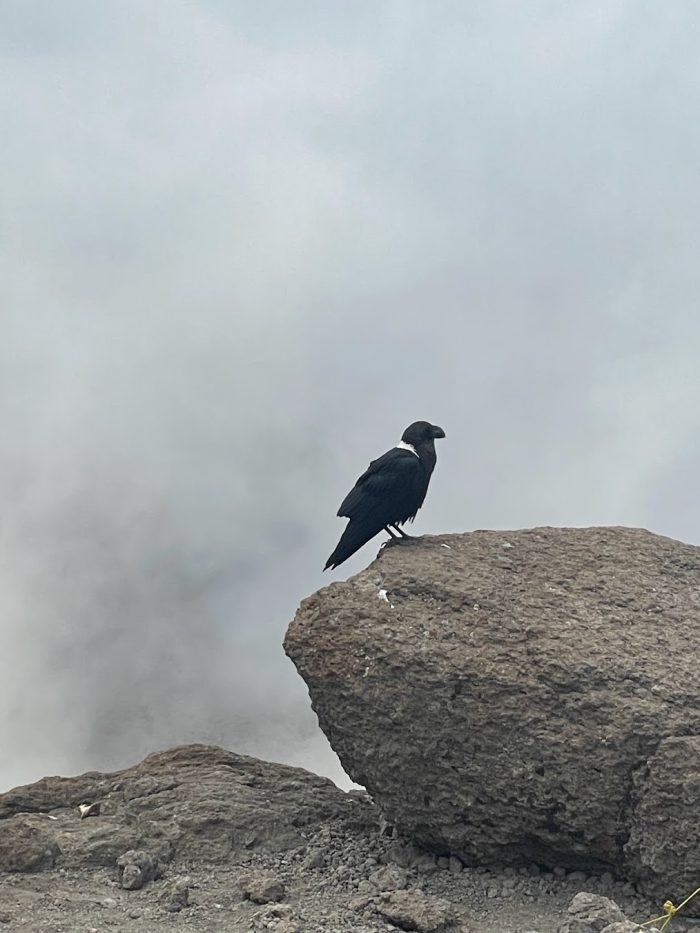
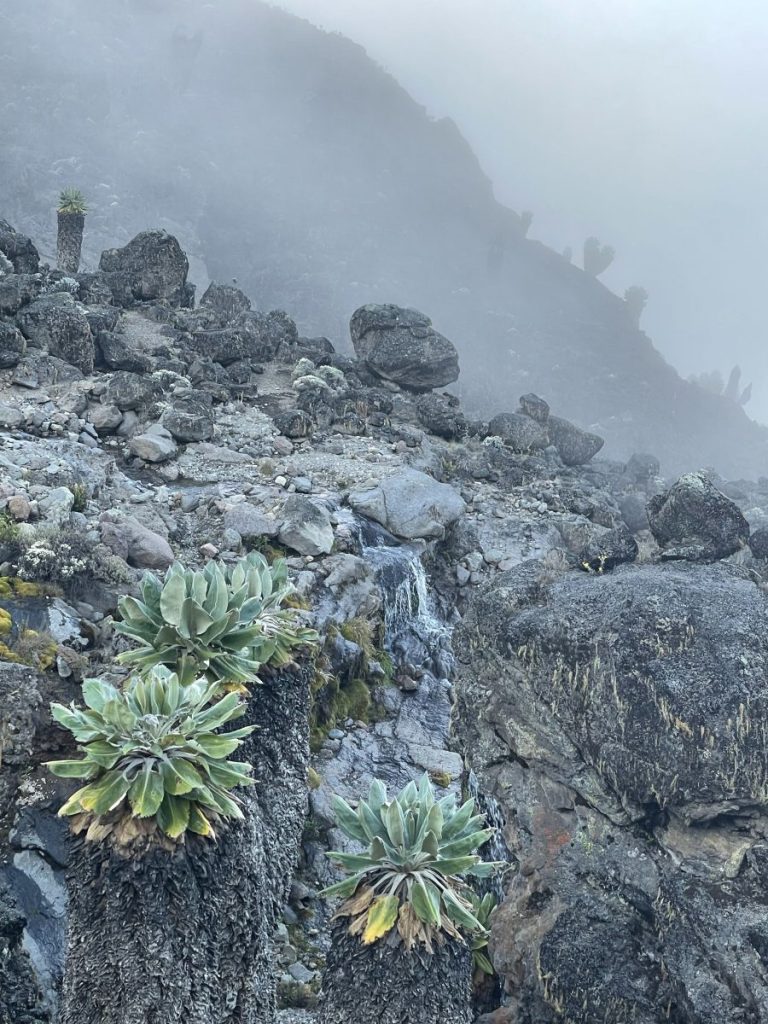
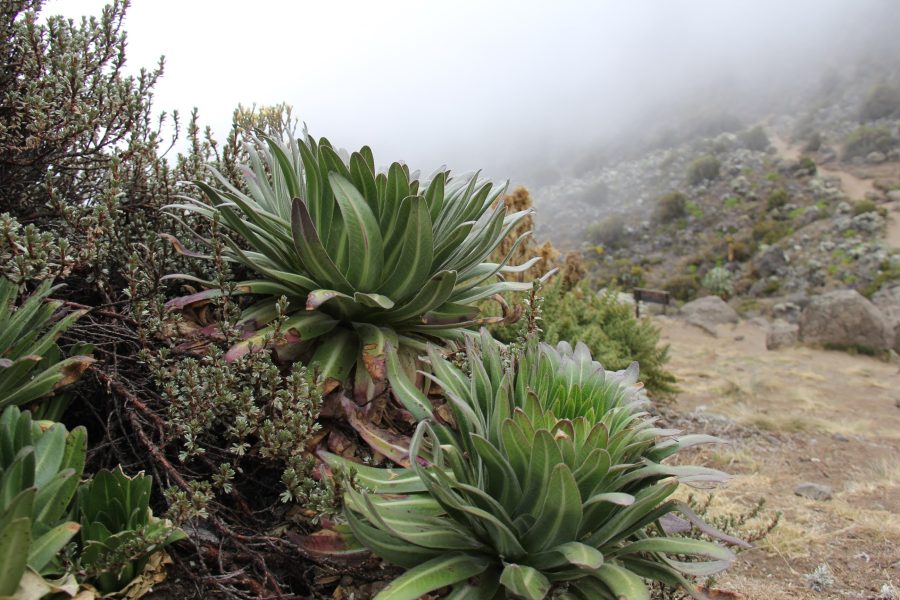
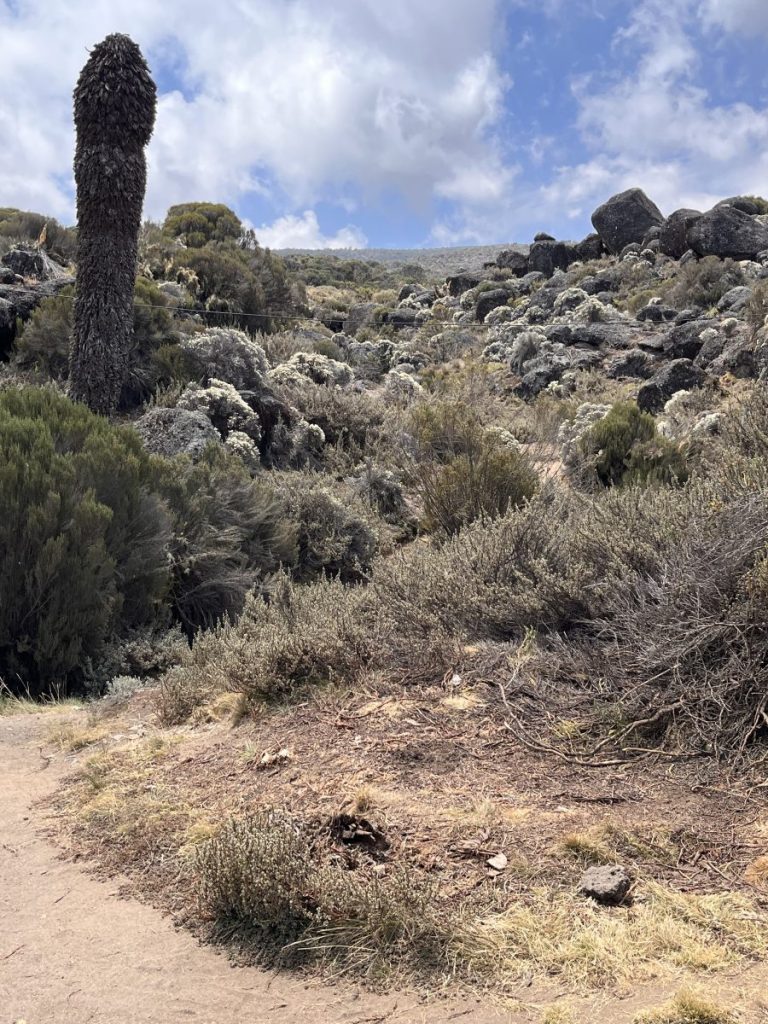
We had been ascending in elevation but our camp for the night was close to the same elevation as the previous night. This meant we were going to have to descend the trail. That was good news as it was more difficult for me to go up than to go down. Each step took a lot of energy and left me panting and feeling out of breath. The guides frequently would tell me to drink more water to help prevent altitude sickness. I wondered how they thought I could breathe and drink at the same time as my body wanted air more than it wanted water. The recommended amount of water to consume is about 3 liters a day. I was never able to get that much down and I think they finally gave up trying so hard to keep me adequately hydrated. Yet, while others around me were feeling the pangs of altitude sickness, I still had not had a headache, nausea, or vomiting. I feel certain that the prehike conditioning I had done many with my group of hikers back in North Carolina and often at elevations above 6,000 ft. had helped. I was also taking Diamox as prescribed twice a day and eating the high energy snacks to provide fuel to my overworked cells. As we descended the path, we came to a section that resembled a set from Jurassic Park. It became very steep, and the terrain was very rugged with deep grooves in the sides of the mountain. There were fairly large trees with moss hanging from bare limbs. The varied hues in the rock and soil were red, green, brown, and gray. There was a large section that was charred from fires that had occurred about two years ago. There were beautiful desert-like flowers and plants. It was dramatic, stark, beautiful, and eerie all at the same time. The trail was a hard surface with the typical volcanic gravel making it easy to slide and lose your footing. Once again, Matthew watched my every step keeping me safe on the way down this section. We rounded a curve in the trail when Matthew pointed to a place across a ravine from where we were and said that was the camp for the night. I could see we had quite a way to descend before crossing the bottom of the ravine and then hiking back up to the camp. I wanted to sit down and not budge. I was tired and this looked like a long way off yet to go. But the other side of my brain kicked in and told me to take it one step at a time and get there. Matthew and I were lagging a little behind the group, but we caught up as we ascended the trail to the camp. It was a welcome sight to have the crew members greet us on our way up, take our packs, and gather around us to sing the ritual welcome song as we made it into Karanga Camp. Though the evening fog and clouds were rolling in there was still light to get the group picture at the gate and then look for a spot to find connectivity on our phones. The White Napped Ravens searching for crumbs from the camp looked rather ominous in the mist. The usual tasks of setting up our gear in the tent, freshening up, having a hot meal, gazing at the spectacular starry sky, and settling in for the night seemed routine now. My body yearned for rest night would bring.
Jurassic ParkDesert-like plantsCamp in the far distanceKaranga CampWith AbelWhite Napped Raven
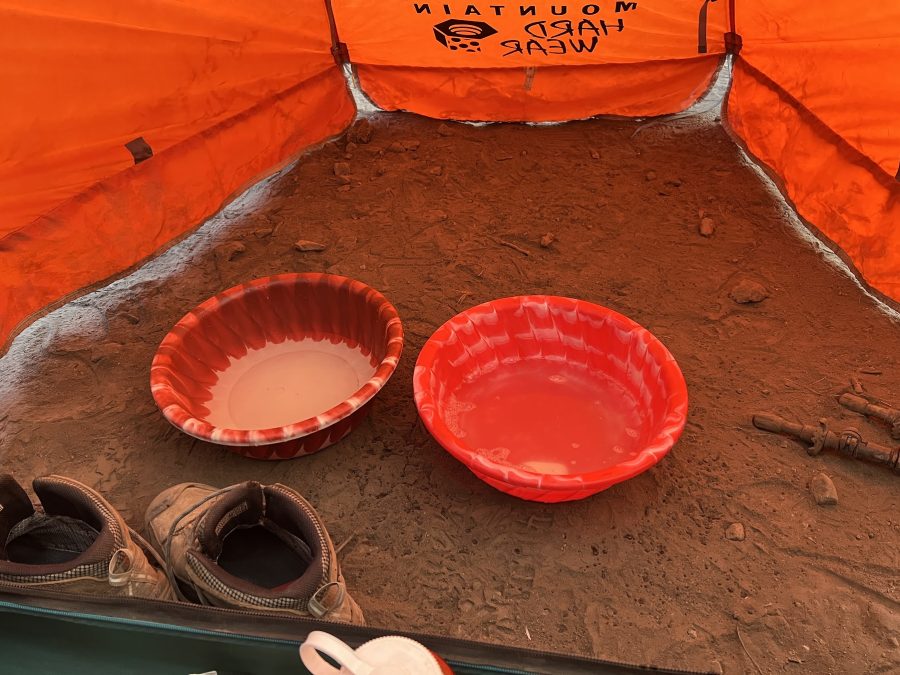
Jo’s alarm sounded too early. It was dark outside and way too cold to think of getting up. I let Jo start packing her gear while I stayed in my sleeping bag a little longer. But the day’s adventure was ahead, and I needed to get moving. So, I emerged from my sleeping bag and began the daily task of dressing, stuffing my sleeping bag into it’s sack, and putting on my shoes to begin the day. Outside the zipper entry to our tent, I found my water bottle that I left just at the entrance and discovered it had partially frozen during the night. Then, a crew member showed up with two bowls of hot water to use to freshen up. Sometimes the daily bowls of hot water would show up in the evening but at least once a day we had water to cleanse our bodies. I never figured out how to really use it well as I couldn’t bring the bowl inside the tent and I didn’t want to stand bare footed in the dirt outside the tent, so I would use a cloth and try and wipe the dust, dirt, and sweat from my body as best I could. Once ready, I headed to the breakfast tent to join the group for our first meal of the day. It was usually the same menu of hot oatmeal, fruit, pancakes, eggs, and a meat for protein. The spreadable oil or margarine, Nutella and jam that were always on the breakfast table were so cold I could barely scrape a little onto a table knife. I liked to add a little of the margarine to my hot oatmeal to add flavor and a few calories as well. The Nutella and jam were a nice addition to the pancakes. I would take my water bottle to the table, fill it with warm water and add some electrolyte powder. Next, I would try and find some water to brush my teeth. Since by this time, camp would be packed up, I would often use the electrolyte drink in my water bottle to wet my toothbrush and rinse my mouth. Then I had to fill the Osprey water container that I carried in my daypack in addition to the water bottle. I was always the last one ready to begin the hike, but the others were patient with me and never complained.
Bowls of water to freshen upCamp all packed up
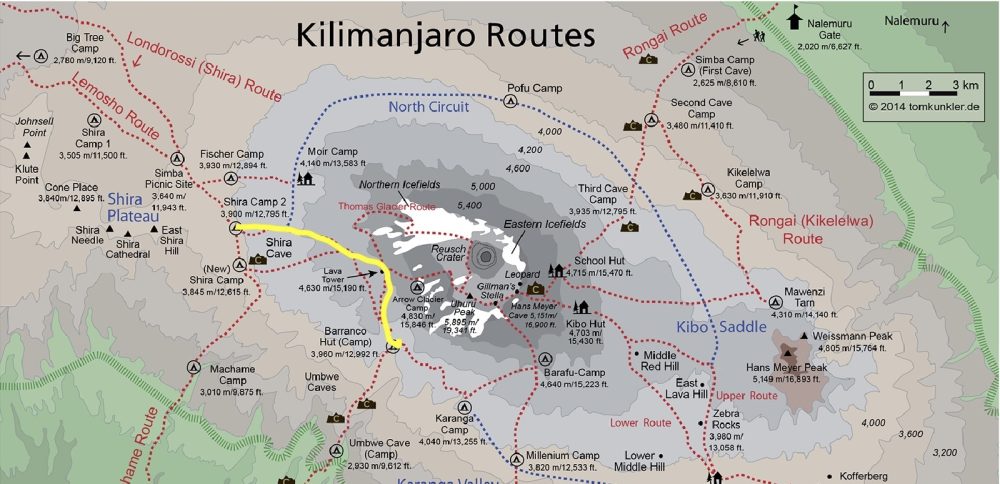
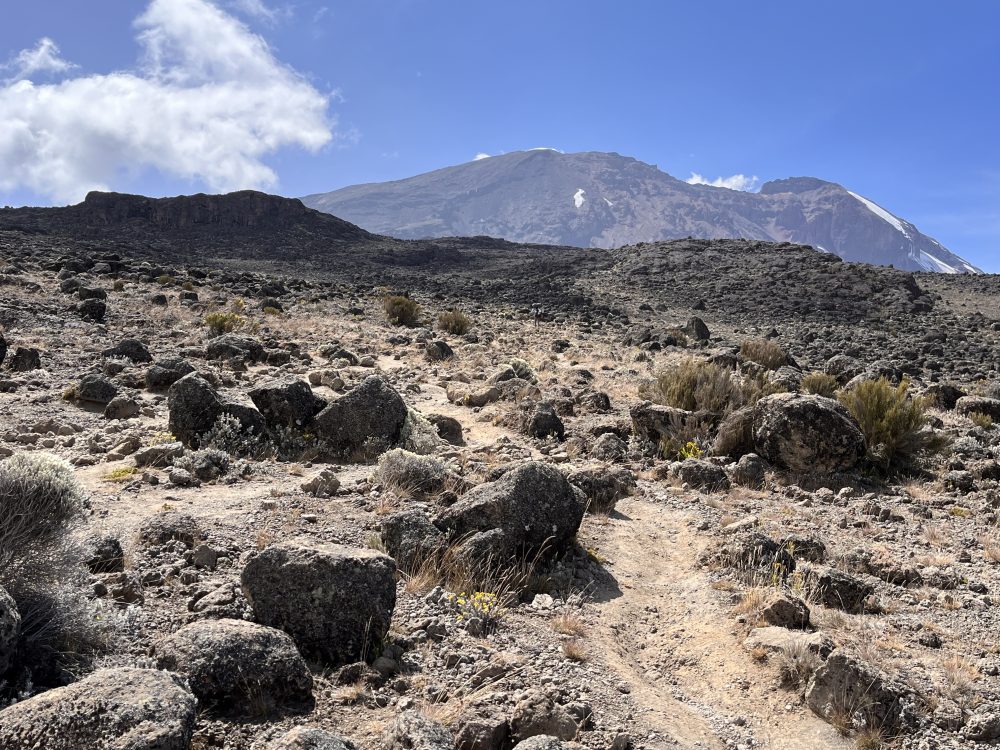
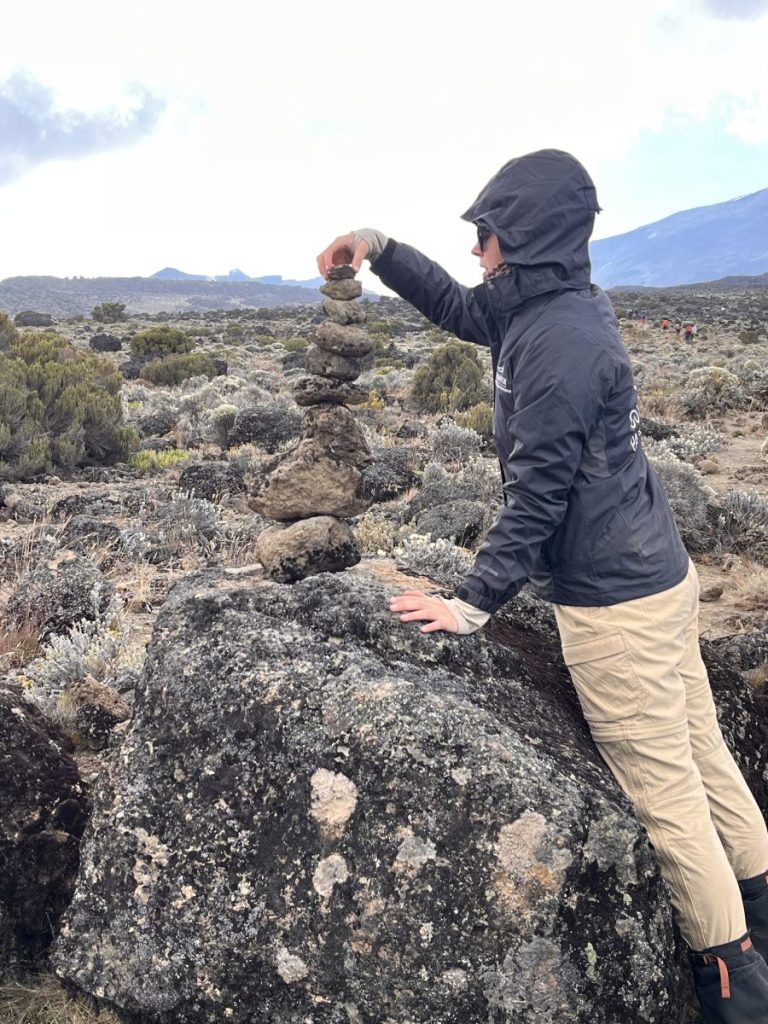
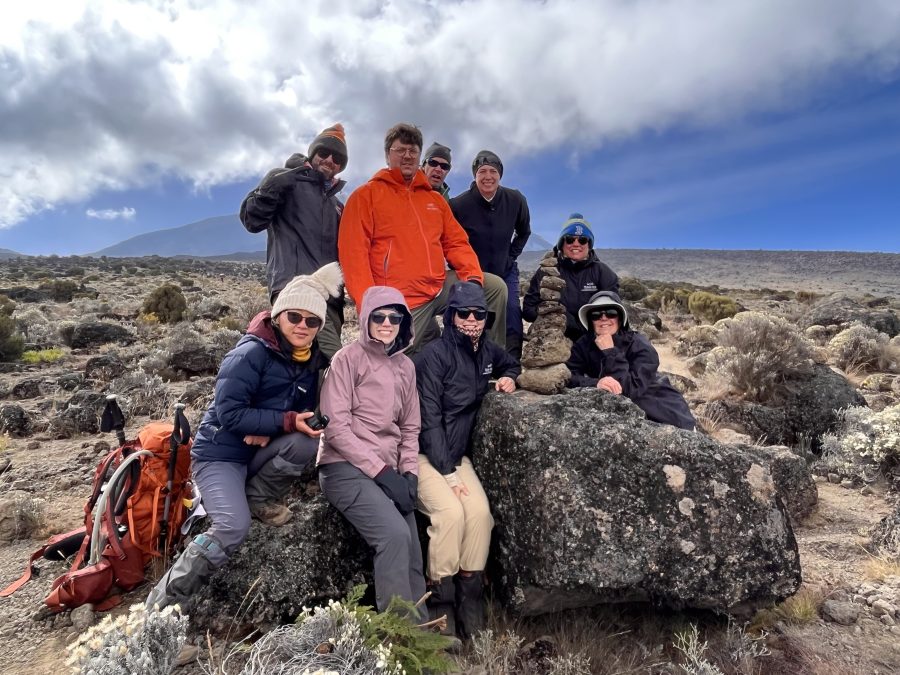
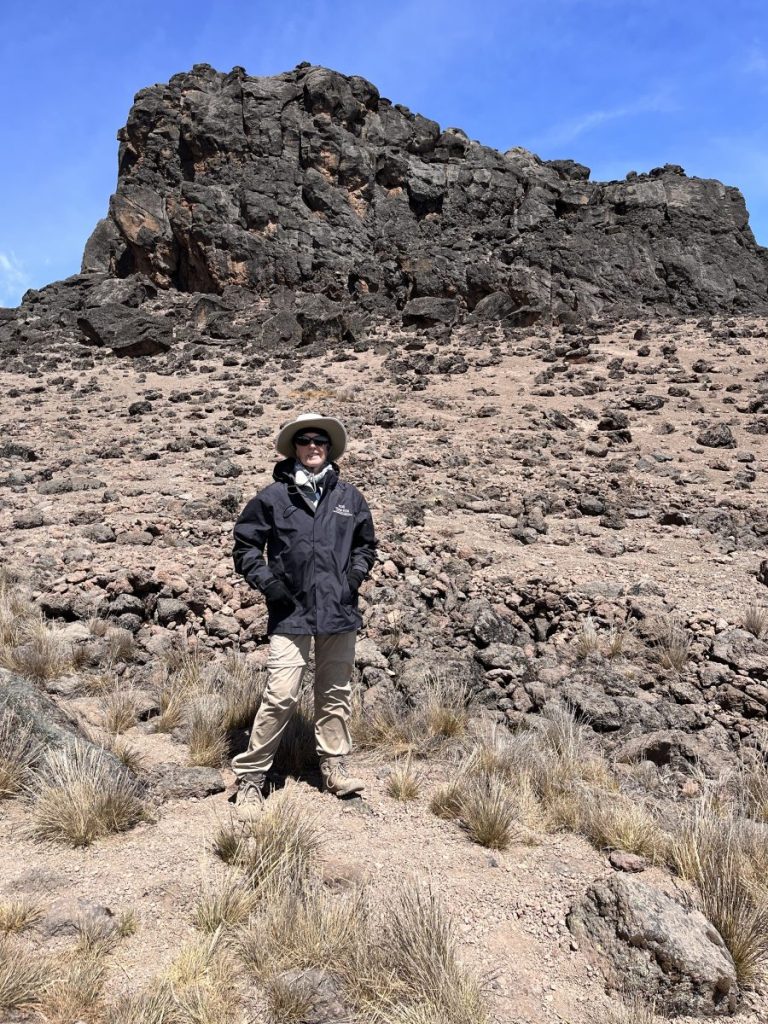
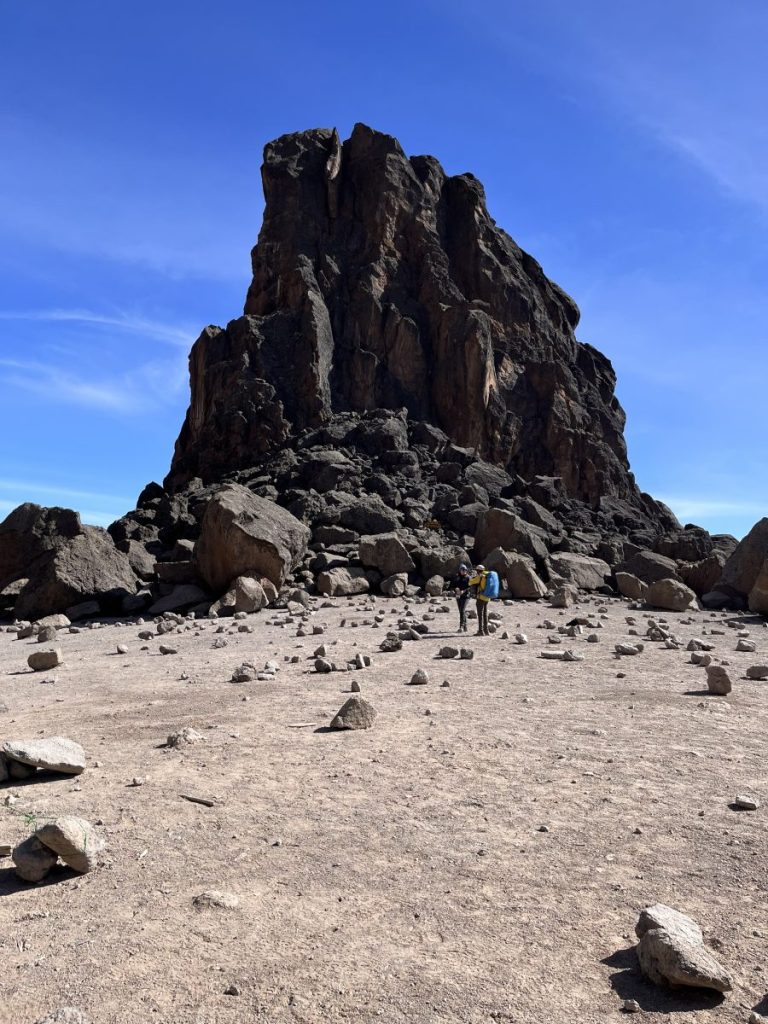
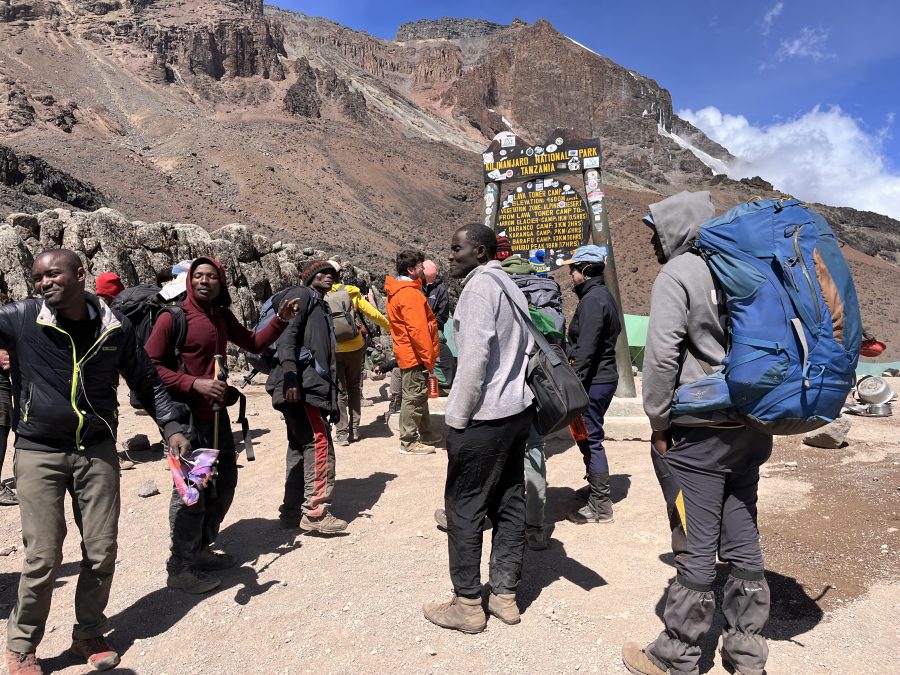
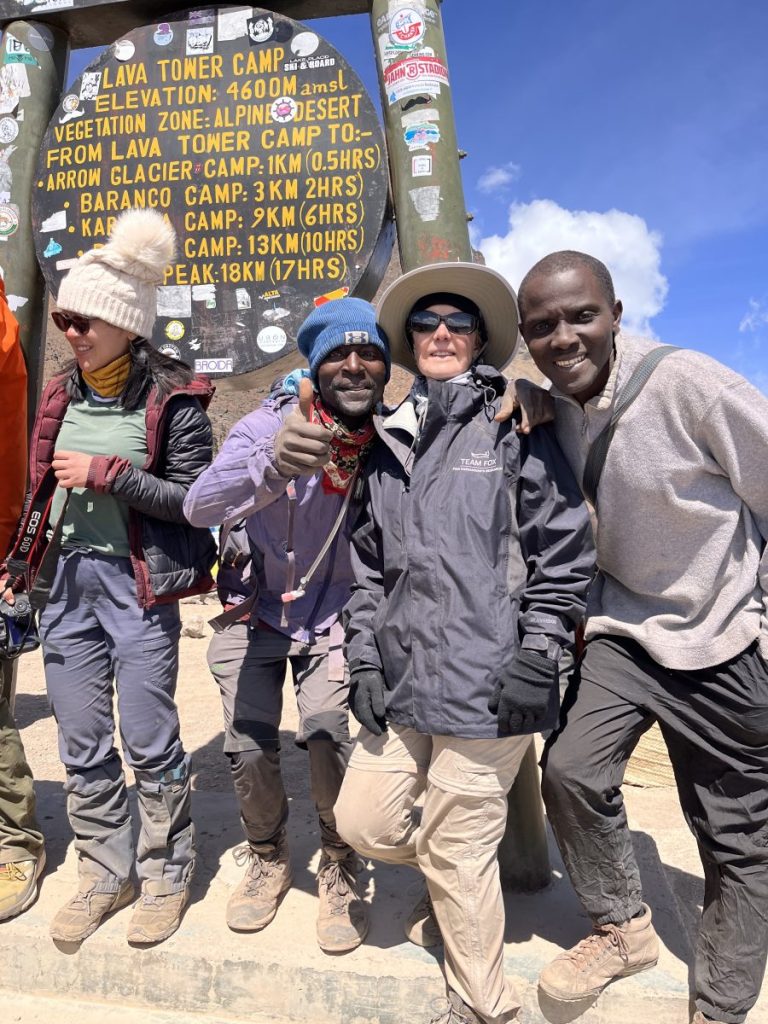
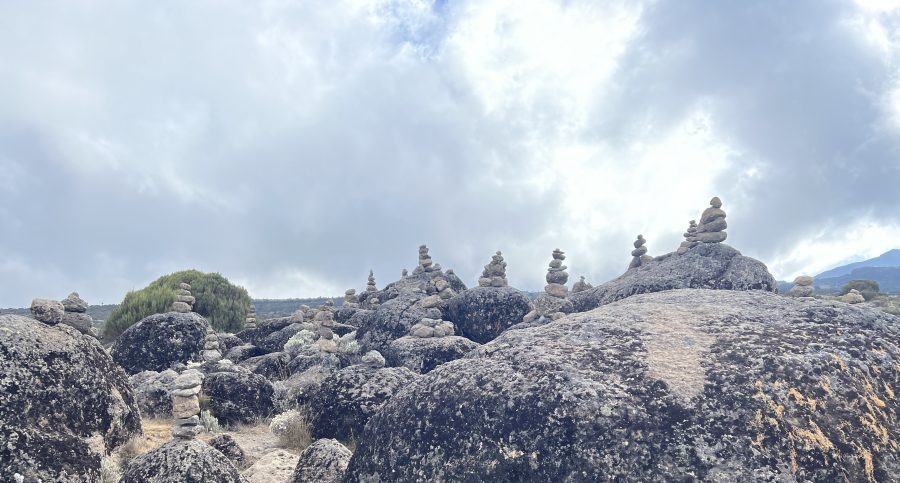
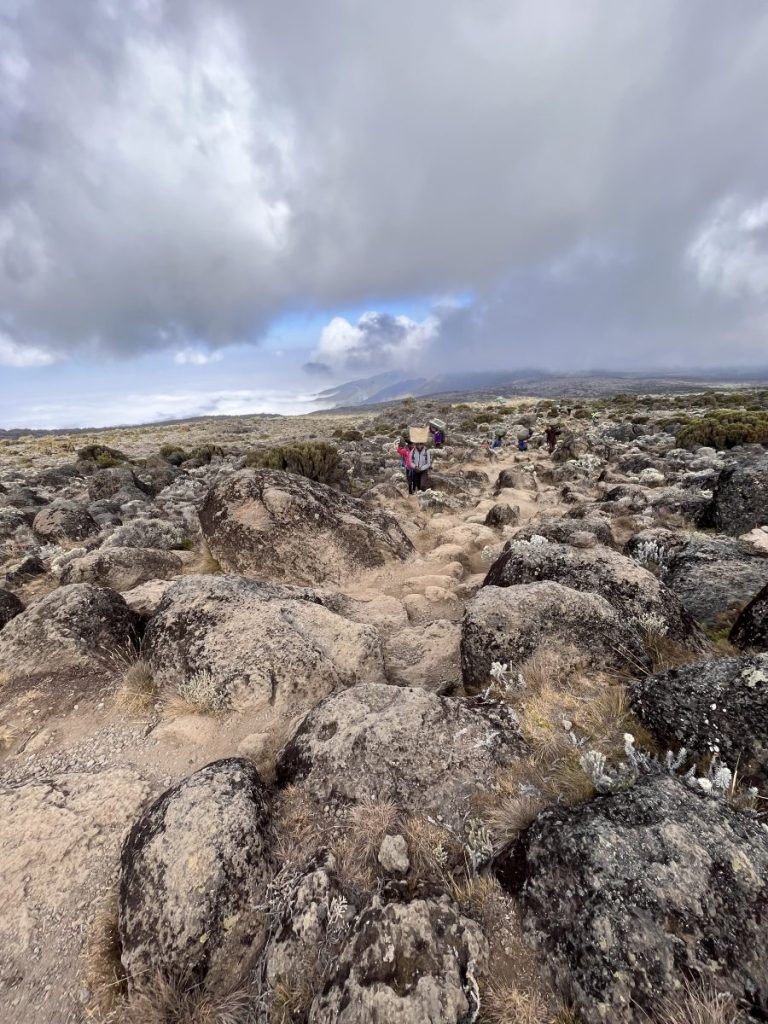
Our route for this day would start at Shira Camp II, travel back through the Temple of Cairns, lunch at Lava Tower and reach the Barranco Camp to spend the night. Our starting elevation was about 12,600 ft. with Lava Tower at about 15,200 ft. and Barranco Camp at 13,000 ft. We would be hiking about 9 miles, so it was a big day ahead. When we got to the area of the cairn towers, we decided to build our own monument. Since I was the oldest group member, I was to place the foundation rock and the others added their rocks in chronological order. Once we finished making our cairn, we took a picture capturing the moment. It was a brief moment as it toppled before we moved on with the hike. The higher we got the terrain changed from the moorland to alpine desert. It became more difficult to find cover for the trail breaks the Diamox demanded. The plant vegetation all but disappeared and it became very barren and desolate. It was a bright day, so the sun shined down on us but due to the elevation, it remained cool enough to leave our long sleeves and pullovers on. Most of the trail was a gradual climb and we moved at a snail’s pace. As we got closer to our lunch destination at Lava Tower, I noticed that Laura was lagging, looked very pale, and stopped to get some medication from her daypack. She had a headache and felt nauseated. Since we were nearing 15,000 ft. elevation she was undoubtedly experiencing altitude sickness. When we got to Lava Tower Camp our porters greeted us with the same happy welcome singing, took our daypacks from us and took pictures of us at the Lava Tower gate post. They had a hot meal waiting for us in the mess tent where we dined and rested before continuing on our way. Others in the group weren’t feeling so well either so the food and rest were very welcome to refresh us before continuing to our camp for the night.
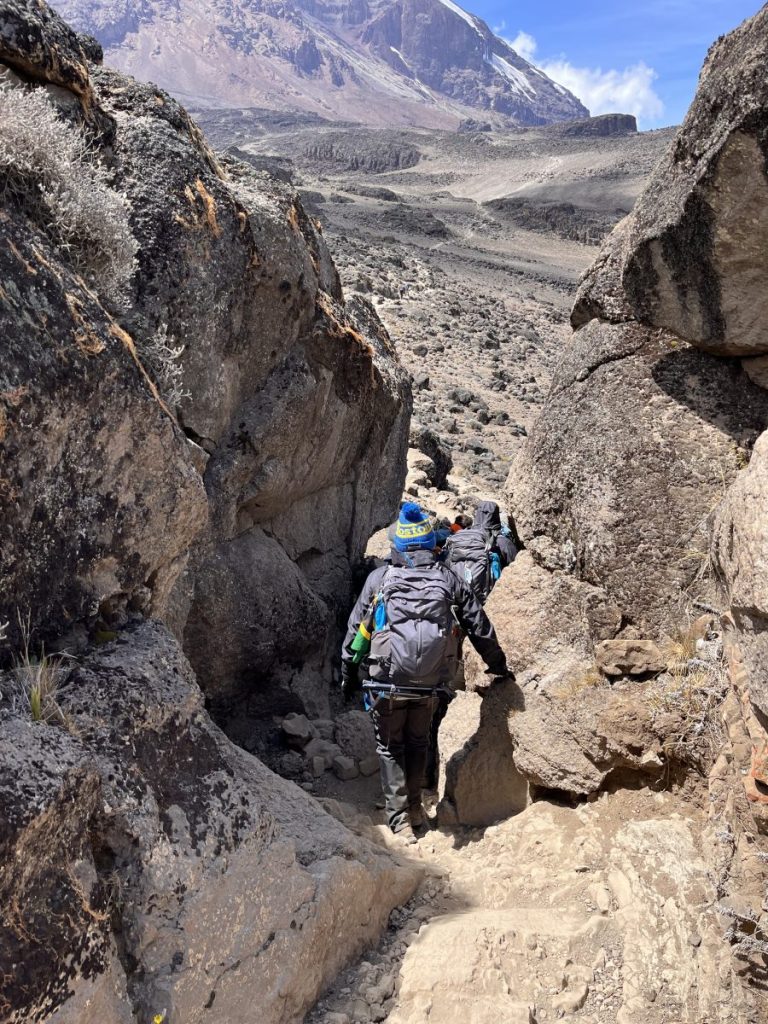
Trail breakBuilding our cairnOur towerA narrow section of trailNearing Lava TowerMe with Lava TowerLava TowerLava Tower Gate PostOur happy crew
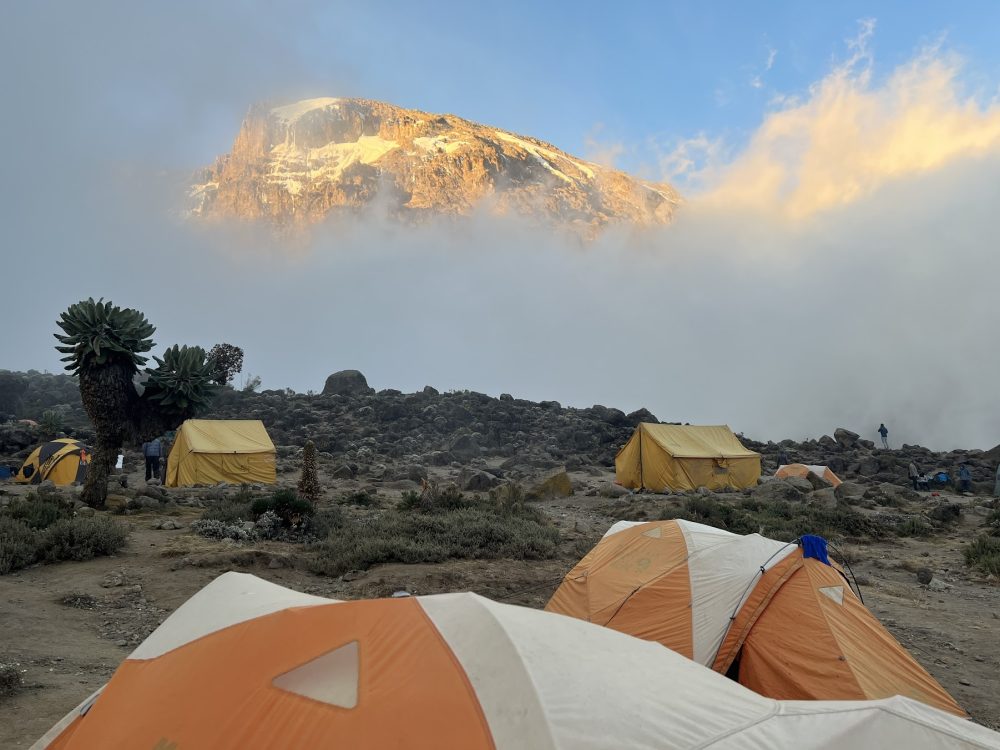
From Lava Tower the trail descended down an open area where the trail was mainly the volcanic gravel scree making it easy to slide and fall. The rugged cliffs to the left of the trail were majestic and glowed in the afternoon light. As we got close to Baranco Camp, we came upon an oasis with a stream flowing down the mountain. The water cascaded over rocks and made waterfalls. It fed beautiful desert plants turning the barren land into a beautiful, lush area. I stopped to take pictures but January, our lead guide, took my phone, put it in his pocket and said we needed to hurry, or we would be hiking in the dark. We arrived in camp just at dusk and the light on the mountain towering above us and peeking out from the clouds was a stunning sight. The evening ritual of unpacking, dining, gazing at the beautiful stars, and snuggling down in my sleeping bag for the night was a little easier now that I was getting used to it. It had been a long, hard, tiring day full of beauty and splendor and sleep came a little easier this night.
Towering cliffs above usOasis vegetationThe peak above the clouds
Our wakeup call came at 6:30 that first morning. It was barely dawn, quite cool outside and I didn’t want to budge from the cocoon of my sleeping bag. We had an hour to get dressed, freshen up, pack up our gear and go to breakfast. If unpacking our gear and laying out our sleeping bag and mat had been difficult, packing it all up was even more of a challenge. I struggled every morning trying to stuff my sleeping bag into it’s sack while sitting on the floor of our tent. There was limited room to sort through my belongings and find what I wanted to wear for the day. Getting dressed had to be accomplished in sequences of steps. I had to kneel to slide my long underwear down to my knees, then lay on my back or sit to get them off the rest of the way. The reverse was needed to put the bottom layers on. Of course, the top layers weren’t as difficult. The next step was to get everything back into the duffel bag. Ugh! Socks went on last and to get out of the tent, I had to take my shoes out of the plastic bags used to store them inside the tent, set them outside the opening and figure out how to get my feet in them with my body still inside the tent and then stand up. Jo decided after our first morning that we needed more than an hour to get this done and set her alarm to wake us up at least a half hour earlier than the wake up call each morning. The thoughtful crew would bring your coffee or tea in a cup to your tent opening every morning so if you needed that cup of brew to help you wake up you could count on having it delivered to your tent door.
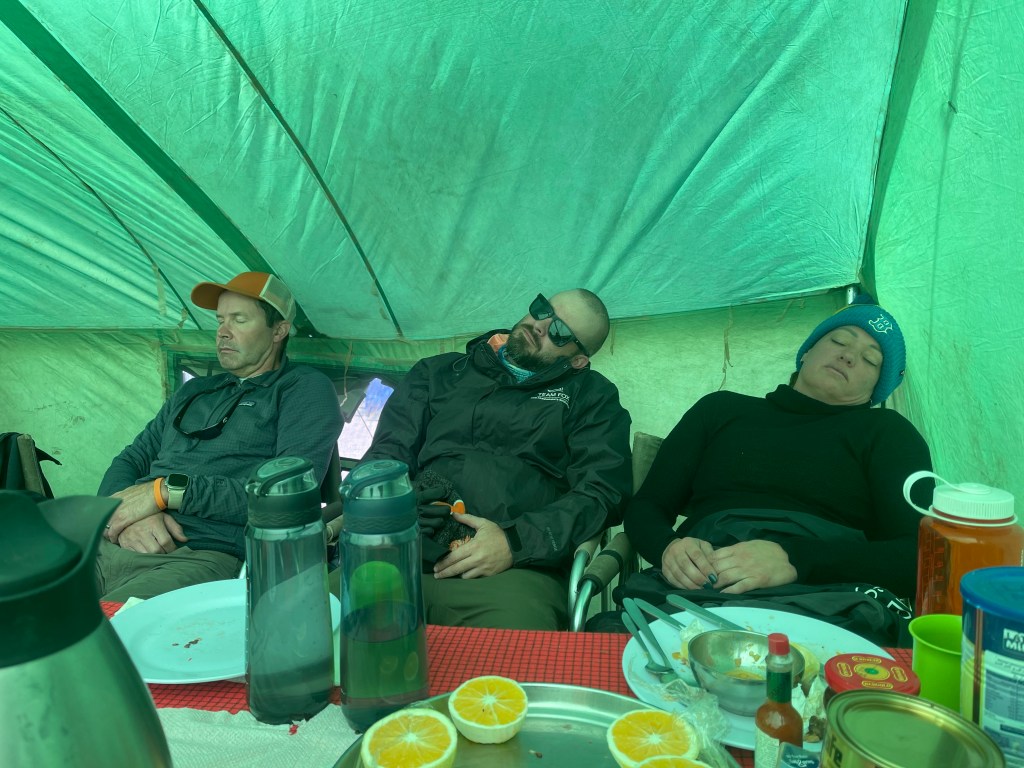
But for me, it was off to the breakfast table in our mess tent to get my morning Hibiscus tea along with breakfast. Each day there would be two thermos pitchers on the table, one had hot water for hot tea in individual packs or powdered hot chocolate. The other pitcher had piping hot ginger tea. Then we were served a breakfast of pancakes, eggs cooked to resemble a large, flat pancake, a large pot of porridge which was thin oatmeal, fresh fruit, and various bread selections. I’m sure there was a meat selection as well, but I did not choose this option. Before we left the table, the cook staff would bring a snack for us to take along for the day’s climb. This was a box of mango juice, muffin, a package of dry biscuit cookies and a few pieces of hard candy. Next, you had a short time to use the porta john, fill your water bottles, brush your teeth, and assemble for the day’s journey.
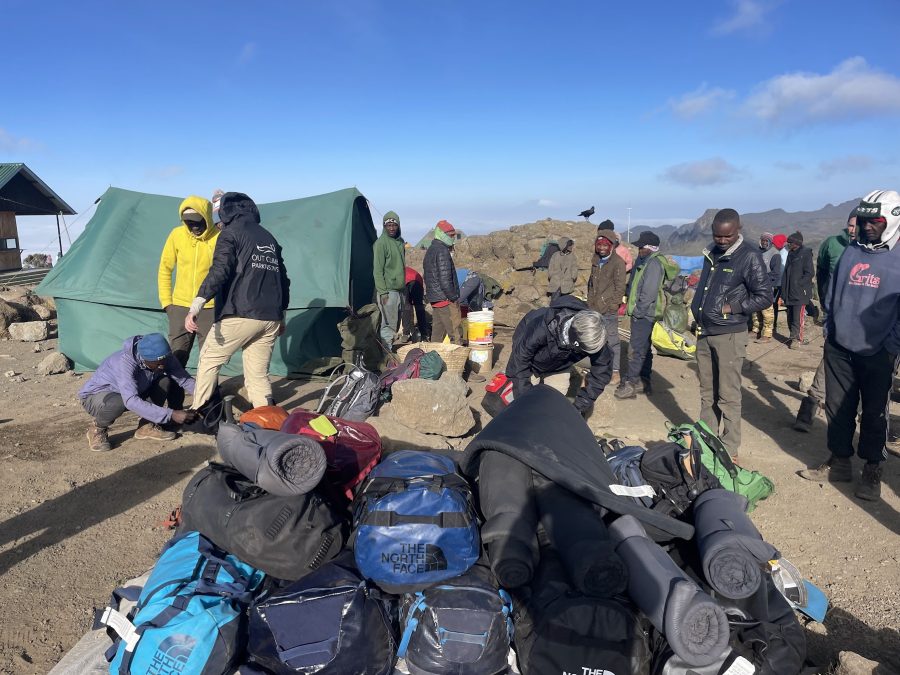
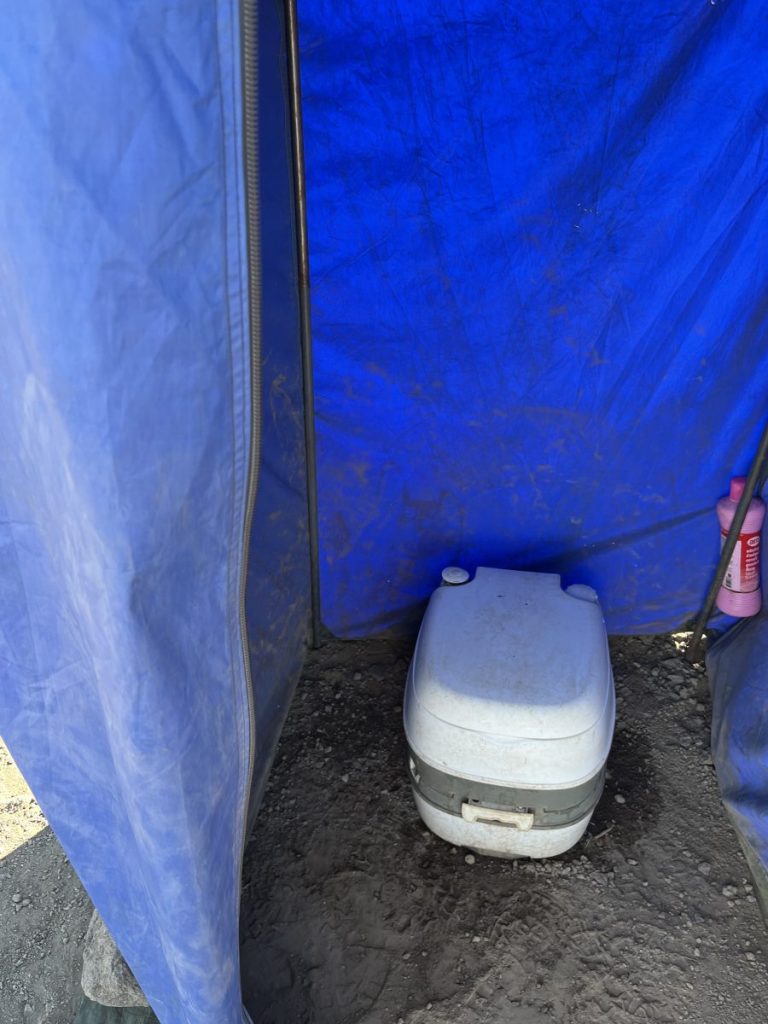
While we were eating breakfast the crew would be taking camp down and packing it up. They would put our packed duffel bags on a tarp in the center of camp so they could pack up our tents. Each crew member had their assigned duty. There was the tent staff, cooking and food preparation staff, porta john staff, guard staff, and our guides. As the various aspects of the camp were ready, the porters/crew would begin taking it to the next campsite. The mess tent and porta johns which were two little, bright blue tents with a zip entry and housed a little porta potty, were the last to be packed up. Once we were ready to go our head guide would start us on our next leg for that day. As we would start our very slow pace, the porters and crew would pass us carrying very large packs often on both their backs and their heads.
morning tarp with all the duffle bagsthe porta johna porter carrying the gear
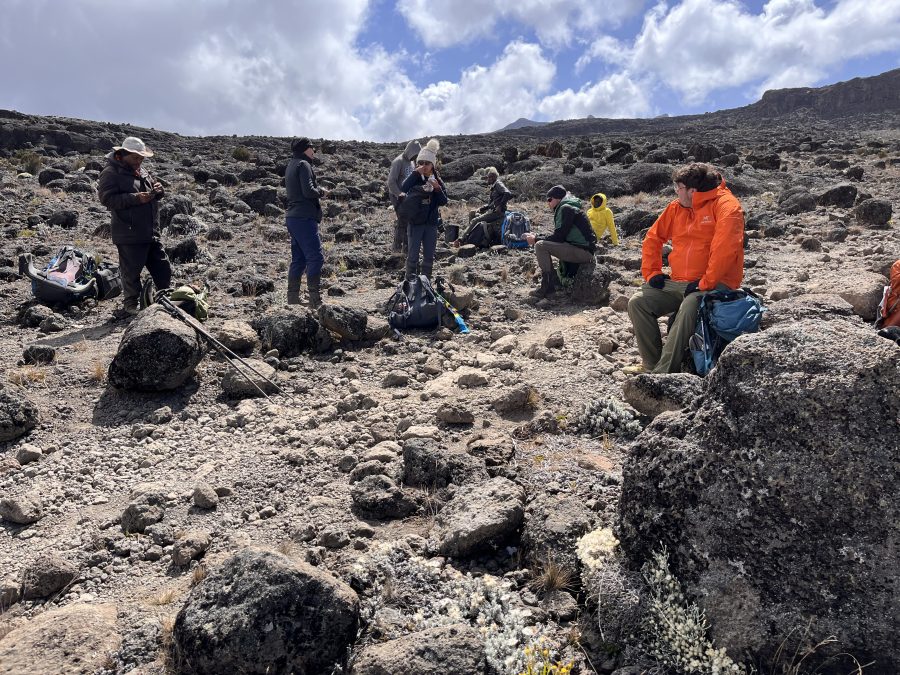
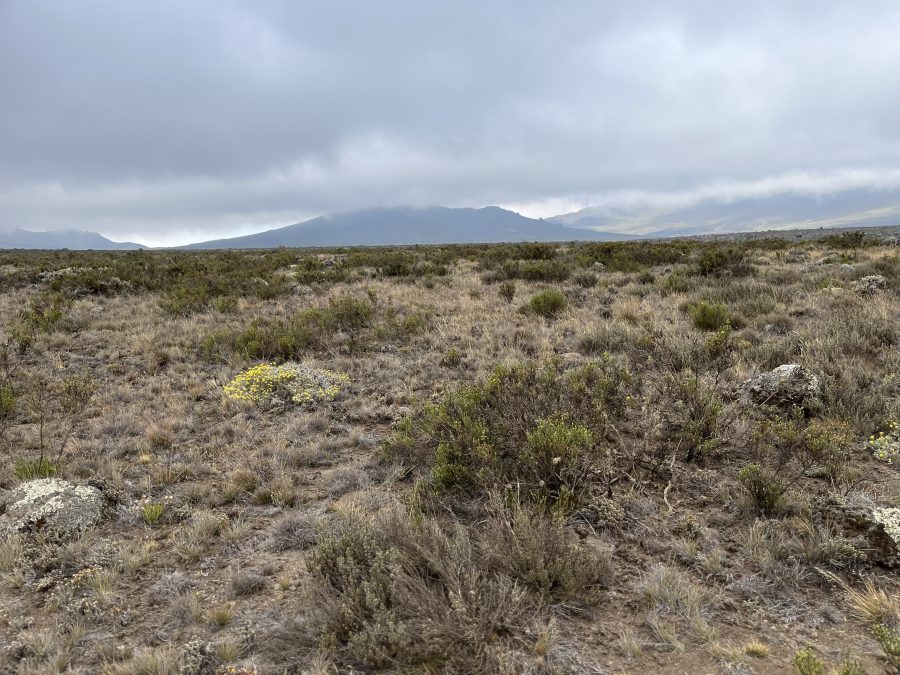
Our destination on day two was to get to Shria Camp II. It wasn’t a very difficult hike for this day but to be honest, I lost all track of time, distance, and elevation gain. I just followed the leader and put one foot in front of the other until we got to the next camp. It seemed to be more of a gradual climb in a vast, desolate area where the vegetation was scrubby and dry. There were white and yellow flowers along the way adding some color and interest to the landscape. We made stops at times for water, trail breaks (emptying one’s bladder), and snack breaks. As we neared the camp, the porters and crew came down the trail to meet us and carry our daypacks the remainder of the way. Once we got to camp, the staff circled around and sang a welcome song where they named each one of us in the various verses. This was a ritual that occurred each time we got to camp. They always had a smile on their faces and took great measures to please and help us with anything that would make our journey lighter and easier. They would be ready to dust off our boots and pants, help us find the tent where our duffel bag had been placed, take our gaiters off or literally anything we wanted or needed. We were treated like royalty. The mess tent would always be set up and as soon as we had our tent settled, there would either be a hot meal or snacks ready for our consumption. On this day we arrived in camp early enough for a nice afternoon break, but after lunch, the head guide told us to gear up for a short walk up to a higher elevation. He wanted to see how we would do going to 13,000 ft. and this would help us acclimate to the higher elevation we would be encountering over the next few days. So off we went up the dry, stony, dusty trail to a place I called the Temple of Cairns. It was full of stone cairn towers obviously stacked by previous hikers. We rested at this destination for a while and then returned to camp for a snack of popcorn and peanuts before the main supper meal. Between the snack and supper, I decided to rinse out some socks, undies, and the very dusty leggings I had worn that day. It turned out to be a big mistake as most of the garments did not dry out for the remainder of the trek despite the very dry air. I think it was too cold to let the bulkier things get dry. I had counted on having the leggings to wear but had to make do with other lower body garments until the ascent to the top when I needed four layers, and our head guide sent my leggings to the cook tent to dry them by the stove so I could wear them on that final push to the summit.
path along the waythe dusty paththe stoney trail white flowers gate post for Shira camp IIour tent when we arrived in camp
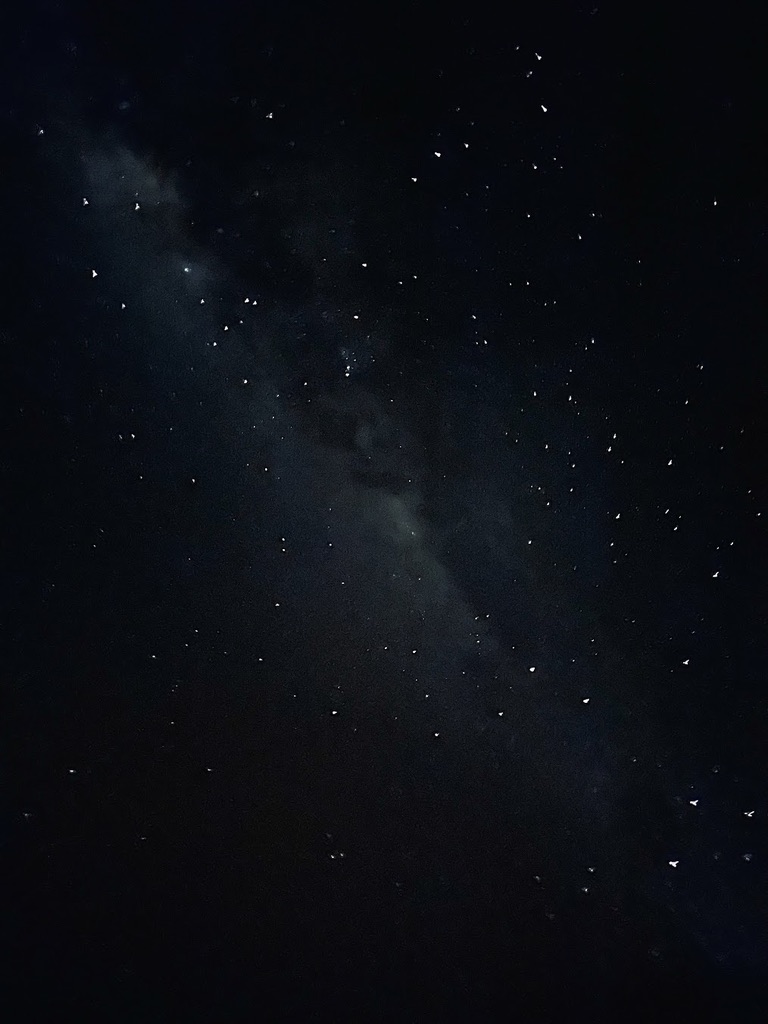
After supper Jo and I made our way to our tent and noted the clarity of the stars and once again saw that cloudy image we call the Milky Way. It was just as amazing the second night as the first night we saw it. I quickly fell asleep but was awake again in the night to go to the bathroom. I was taking Diamox to help prevent altitude sickness and acting like a diuretic is a common side effect. It was too cold to go to the porta john and so this had to be accomplished with some ingenuity in the tent or just outside the zipped opening in what we called the vestibule. Then I had trouble going back to sleep as the sounds of the breeze causing the tent to flap and other noises that I thought surely must be wild animals just outside our tent kept me awake for much of the night. At last, it was morning and time to pack up again and see what the day would bring.








 Trekking Upward